After one week of Spanish classes, the “true” classes for our program in Ecuador began. While the Spanish classes had taken place the week before the official start of the semester, when we showed up to campus the next week it was completely packed! As someone in the ecology and evolution track, my first class was focused on Geographical Information Systems (GIS), a computer program that allows one to display and analyze data on maps for data visualization. It’s not an easy program to learn, but thankfully I had actually taken a GIS course at Linfield about 2 years prior so I was already familiar with the basics.
However, there’s more to a study abroad program than just going to class, and our group (there were 22 of us in total, across both my track and the other track, which was focused on marine ecology) made sure to make the most of our time in Quito outside of class and over the weekends.
One of the first highlights of the trip for me was a climb up Rucu Pichincha, a 4,700-meter (15,400-foot) peak located immediately west of Quito. We accessed the trailhead by a cable car and proceeded to hike towards the peak. Fifteen thousand feet of elevation is no joke. Even though the trail itself was never particularly steep, the thin air wore us out quickly and 5 of the 8 people in our group ended up turning around before the peak. But the three of us who did make it up to the top were treated to a great view of not only Quito but also the mountains on the other side of Rucu Pichincha.
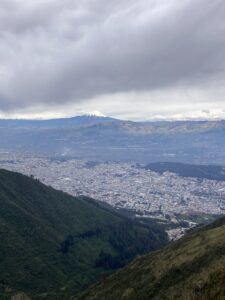
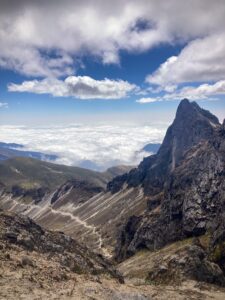
The view of Quito from partway up the trail with Cotopaxi in the background (left), and the view to the west from near the summit of Rucu Pichincha, at about 15,000 feet.
We also traveled a short distance to visit the town of Otavalo, located about 2 hours or so north of Quito. A vibrant center of the traditional lands of the indigenous Otavalo Kichwa people, Otavalo is famed for its Saturday market. On busy days, the market can spread across a third of the city and is claimed to be the largest artisan market in South America. It certainly felt like it, as the stalls seemed to stretch on forever, no matter where you went. People were selling various goods ranging from basic souvenirs to handicraft jewelry and clothing, to expensive artisan sculptures and art pieces. You’d be hard-pressed to not find anything you were looking for there.
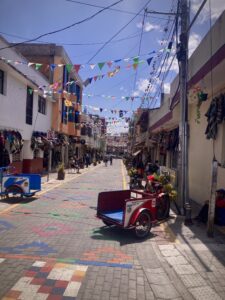
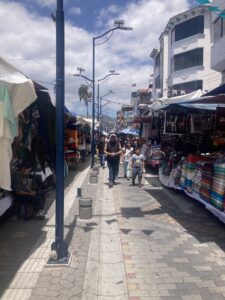
The streets of Otavalo during the Saturday market, around the outskirts of the stalls (left) and in the central square (right).
Overall, I feel I am beginning to settle well into Ecuadorian life. The food is excellent, the people are nothing but kind and friendly, transport is cheap and easy to find, and the university is a vibrant campus with lots of student life. What more could you possibly ask for?
Kai