Deprecated: Function WP_Dependencies->add_data() was called with an argument that is deprecated since version 6.9.0! IE conditional comments are ignored by all supported browsers. in /chroot/home/a1e0f025/dab19c68f8.nxcli.io/html/wp-includes/functions.php on line 6170
Deprecated: Function WP_Dependencies->add_data() was called with an argument that is deprecated since version 6.9.0! IE conditional comments are ignored by all supported browsers. in /chroot/home/a1e0f025/dab19c68f8.nxcli.io/html/wp-includes/functions.php on line 6170
University of San Francisco de Quito (USFQ) , Quito:
A full Spanish immersion program located in Quito, the capital of Ecuador.
Spend a semester living in Andes! Quito is a bustling and historic city and UNESCO World Heritage site of approximately 1.69 million located at an altitude of over 9000 feet.
Explore with USFQ’s Office of International Programs, who organizes excursions around Ecuador, including to the Tiputini Biodiversity Station in the Amazon.
Immerse yourself in the Spanish language with your host family and by joining one of USFQ’s student clubs.
Adjusting to life on the Galápagos can be a little difficult at first. Quito is a massive city with tons of things to do and places to see, while within a few days on San Cristóbal you will have seen everything you possibly can within walking distance of Puerto Baquerizo Moreno. To some people this might feel stifling or trapping, but I personally enjoyed the change of pace. Besides, we also had our classes to keep us busy.
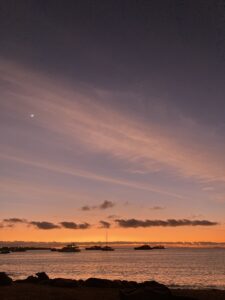
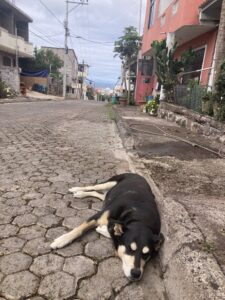
The streets and sunsets of Puerto Baquerizo Moreno, San Cristóbal.
Our first course in the Galápagos was Island Biogeography, focused on the mechanics of island formation and how an island’s location and geography affect the species that move to and evolve on it. The Galápagos, with its extensive list of endemic species (‘endemic’ meaning that it is only found in a single area, in this case the Galápagos), is a prime location for learning these concepts. Our knowledge was also augmented by extensive field studies. Our first major one was a 3-day trip to the nearby island of Santa Cruz.
Santa Cruz is the most populated island on the Galápagos, with 15,000 people, and as such, it is generally considered the ‘main’ island, at least for tourism operations. To get there from San Cristobal, you must take a 2-hour ‘water taxi’; while I personally never have much trouble with boats, the high speed and rough seas were an issue for more seasick-prone people.
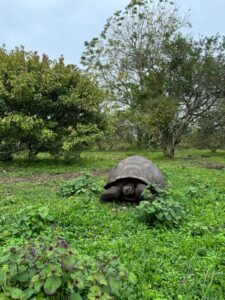
A Galápagos giant tortoise in the Santa Cruz highlands. This one was probably about 2 and a half feet tall!
Once on Santa Cruz, we spent the first day on the southern half of the island, visiting a tortoise sanctuary and a highland preserve to get a better understanding of the Galápagos’ famous giant tortoises, and how they serve an important role in the Galápagos’ terrestrial ecosystems.
The second day was focused more on the aquatic environment; we traveled to the northern end of the island and spent the day on a boat to North Seymour Island, a small island (less than 1 square mile in size!) just north of Santa Cruz. There, we took a snorkeling trip to see the local marine wildlife and took a small hike on North Seymour to observe the nests of various seabirds like the blue-footed booby and magnificent frigatebird.
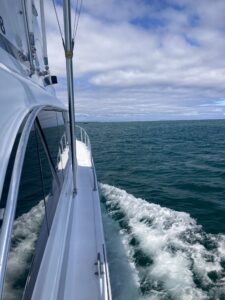
Sailing to North Seymour, off the coast of Santa Cruz.
The rest of the second day and the first half of the third day, we essentially had to ourselves to explore Santa Cruz’s main town of Puerto Ayora. It was a significantly larger town than Puerto Baquerizo Moreno, with more shops, restaurants, and hotels, but definitely felt more ‘touristy’ than San Cristóbal did. However, having spent a couple weeks on San Cristóbal at this point, it was good to get a feel for a different island in the archipelago. Plus, the tourist aspect gave us a good opportunity to buy souvenirs!
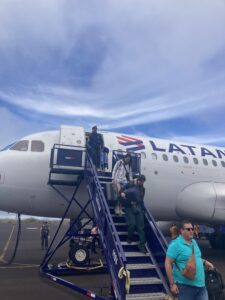
After seven weeks on the Ecuadorian mainland, it was finally time for us to transfer to the Galápagos, where we would spend the remaining ten weeks of the semester. USFQ’s Galápagos campus is located on the island of San Cristóbal, the second most populous island in the archipelago. To get there, we took a flight from Quito direct to San Cristóbal with a short stopover in Guayaquil to pick up some additional passengers.
Disembarking at San Cristóbal.
My first impressions of the Galápagos, upon arrival, reminded me in some ways of the arid parts of Hawai’i, where I grew up and still live; the mix of low, dry vegetation with rocky shores and sandy beaches was similar to parts of O’ahu in the dry summers. However, there were two major differences that were immediately apparent; first, the lack of mountains and second, the extent of human habitation.
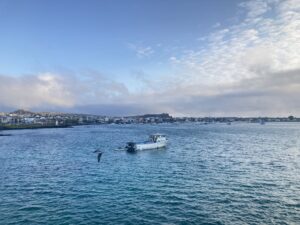
San Cristobal is estimated to have a population of around 7,000 people, the vast majority of whom live in a single town, Puerto Baquerizo Moreno. While that might still sound like a lot of people, consider that McMinnville has a population of around 35,000. So Mac – which most people probably wouldn’t consider to be a very large town – has around five times as many people as the entirety of San Cristóbal!
The bay of Puerto Baquerizo Moreno. Most of the town is visible from here.
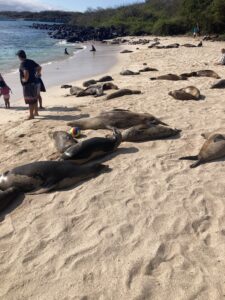
Obviously, though, this is to be expected – after all, the Galápagos is famous not for any big towns and crowds but rather for its wildlife and natural environment. And indeed this was also evident; for instance, we encountered sea lions almost immediately after arriving, laying about on the beaches and even in the streets in parts of town close to the shore. While I’ve seen seals and sea lions in the wild before, the sheer number that were sprawled out on the beach was shocking.
Sea lions lounging on the beach at Playa Mann, right next to campus.
The USFQ campus is located on the northern end of town, right in front of Playa Mann, the town’s main beach. Like in Quito, we all lived with local host families; this time, I lived with a family of four. The environment there was really different from my host experience in Quito, but it wasn’t a bad change. While we had the weekend to re-orient to life on the islands, when Monday came around, we went right back to work to take our first Galápagos classes.
After our week in the Amazon, our Tropical Ecology course shifted focus from the Amazon rain forest to the mountainous highlands that surrounded Quito. While this cold, grassy environment might not be the first thing you think of when you hear “tropical”, since they are in the tropics regardless, they can still be considered a tropical environment.
The highlands of the northern Andes are known as the páramo, and are classified by low shrubs and grasses, high winds, and fluctuating temperatures, much like many other mountainous environments around the world. Much like with the Amazon, our understanding of this environment was deepened by a long field study, although this one was only three days, quite a bit shorter than the almost week-long Amazon trip.
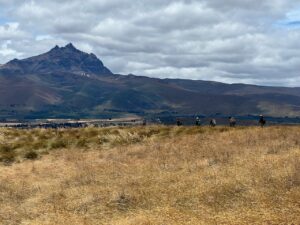
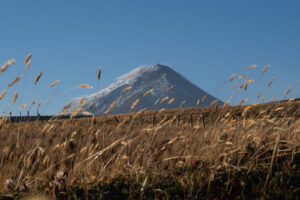
The Ecuadorian highlands, with Rumiñahui in the background.A shot of Cotopaxi in the Ecuadorian highlands.
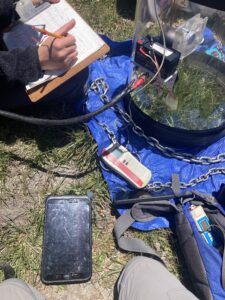
During this trip, we were based out of a mountain lodge on the slopes of Rumiñahui, a small mountain just north of the Cotopaxi volcano, arguably Ecuador’s most famous mountain. It was an older but very cozy place, and stayed nice and warm during the nights, when the temperatures would sometimes drop below freezing due to the altitude, dry climate, and high winds. Our fieldwork on-site consisted of soil sampling and observational work, using soil nutrient and chemical analysis devices to determine the quality and water-carrying capacity of the soil; the soils of the South American páramos also function as massive water reservoirs, meaning that they are extremely important to not only Ecuador’s natural ecosystems but its human residents as well. We also spent a lot of time hiking around the nearby mountains and identifying local plant and animal species so as to better understand these mountain ecosystems.
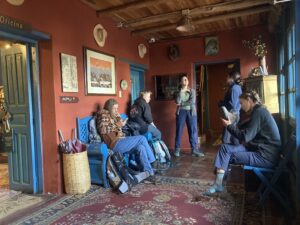
Our survey group getting ready to conduct fieldwork.Field survey equipment for soil sampling in action.
Overall, while the páramo trip might not sound quite as exciting as our week in the Amazon, I personally found it to be really interesting and enjoyable, with a lot of time to ourselves to explore this area of the Ecuadorian Andes on our own terms in addition to our class activities. However, our time in the mainland was coming to an end; soon, we would be transferring to the USFQ’s Galápagos campus, where we would be spending the rest of the semester.
While it was a shame to be leaving soon, the prospect of going to the Galápagos – the location this program is focused on, after all – was extremely exciting to all of us.
Our second main course was focused on Tropical Ecology, and our new professor’s approach was a very hands-on. In his opinion, the best way to study a complex tropical ecosystem like the Ecuadorian Amazon, was to go there ourselves and observe it in-person. So that was exactly what we did – spending five days deep in the Amazon rainforest, miles and miles from any major city. It was so isolated that even reaching our field station took an entire day!
Our journey began at the Quito airport, where we took a 2-hour flight over the eastern cordillera of the Andes to a city known as Coca. From there, we embarked on a small motorboat that took us about 40 kilometers down the Río Napo. Due to a drought in the area, our captain had to navigate shallow waters that made the journey take an additional two hours. We then disembarked at an oil drilling company’s base camp. Oil drilling is a major subject of debate in the Amazon, as it is a big part of Ecuador’s economy, but is obviously very destructive to the environment.
From the oil company camp, we rode by bus, which took us down an access road for another 50 kilometers and 2 hours (the road was unpaved and very windy) through the jungle. We then took yet another motorboat which took us the last 50 kilometers down the Río Tiputini to USFQ’s Tiputini Biodiversity Station, 3 hours later. After a full dawn-to-dusk day, we arrived at our destination. There was no road, settlement, or infrastructure for miles. Coca, the nearest major town, was now over 60 miles away.
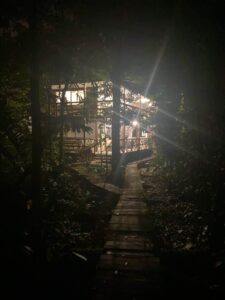
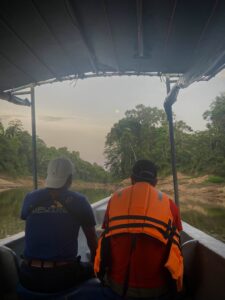
Our field station at nighttime.Traveling down the Tiputini River by boat.
The next day, we went into the jungle. We spent the first day hiking and simply observing the incredible jungle, to get accustomed to the terrain, climate, and wildlife. As someone who grew up hiking in the jungles of Hawai’i, I thought I knew humidity, but nothing compares to the Amazon. It was so bad that during our downtime, we would turn on the generator and sit in the lab, the only building with A/C, for hours.
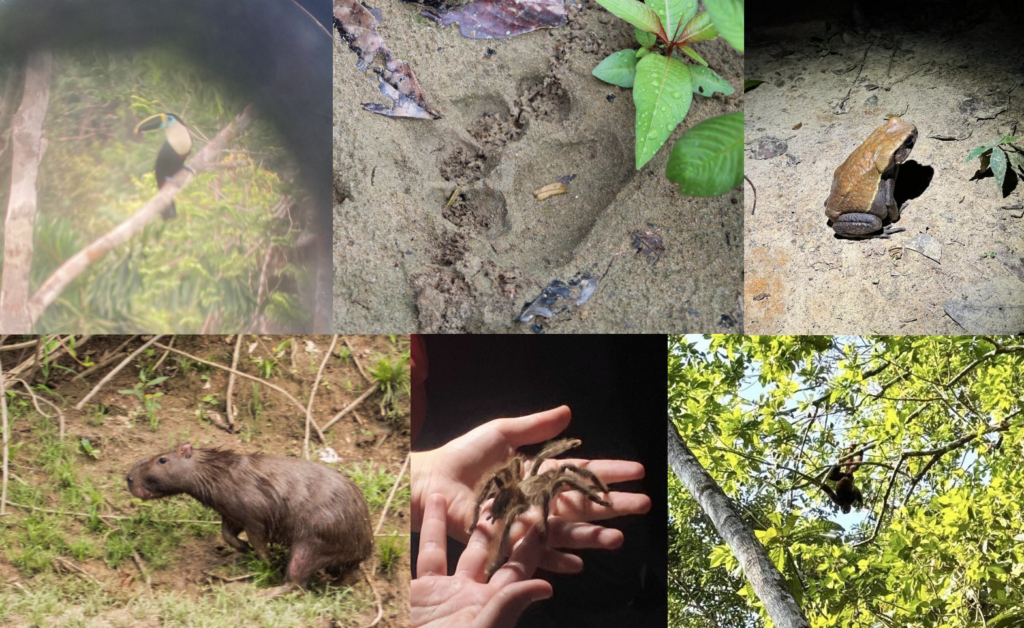
The dense jungle foliage and multitude of dangerous spiders and insects were also a cause for concern, making hikes generally a strenuous experience. However, it was well worth it in the sheer variety of wildlife we saw – from tropical birds like macaws and the hoatzin to simians like the squirrel monkey and golden-mantled tamarin to aquatic mammals like the capybara and giant river otter. We even found prints from a jaguar, but never saw the animal itself. And, of course, there were countless insects from giant centipedes to the infamous bullet ant.
A small (blurry) collage, moving clockwise: a white-throated toucan, jaguar print, giant toad, capybara, tarantula, and howler monkey.
Our later days were focused on interactions between indigenous peoples living in the Amazon and the “outside world”. Many of the Amazonian tribes have only recently been connected to the industrial world (two tribes even remain uncontacted), which has led to many negative interactions with Ecuadorians. These range from personal disputes between tribespeople and outsider hunters and fishermen to manipulative contracts and agreements made by oil companies to allow drilling on tribal territory, with little given in return. To further augment our understanding of the local peoples in the area, we visited a nearby indigenous village that had been connected by a road about 10 years prior.
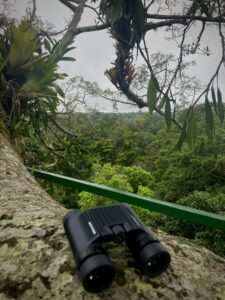
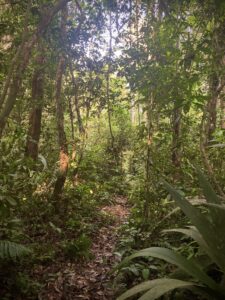
The view from a treetop in the Amazon.A trail in the Amazon.
At the end of our stay, we had a lot of time to reflect on our experience during the long journey back home. While we were only in the Amazon for about five or six days, it was genuinely a life changing experience that will stick with all of us for a long time.
In the second week of our GIS class, Geographic Information Systems and Science, we had our first field study! As someone who picked out my Environmental Studies degree because of my positive experiences with conducting field work, I was looking forward to getting out there and getting our hands dirty.
This first trip was to the Mindo cloud forest, a highland jungle area northwest of Quito. Because of the difficult mountain terrain around Quito, we had to take a roundabout way to the north to reach Mindo, but once we arrived we were blown away. Compared to Quito’s dry arid grasslands, the jungles of Mindo were a completely different world. We spent three days there in total, staying in the Bellavista Lodge, which was a super nice place with a really cool room layout where you used a central ladder to access the different floors with each floor being its own “room”.
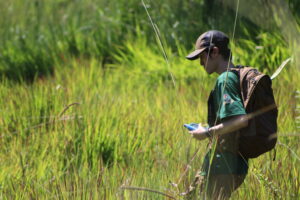
We spent most of the time hiking and logging points on GPS units to upload and work with later on, but we also had plenty of time to explore the area on our own time.
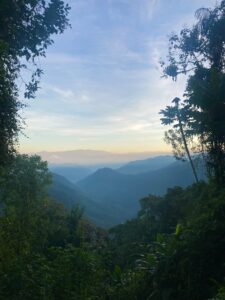
Myself, conducting some field work.The morning sunrise in Mindo.
One of the biggest things about Mindo was its great diversity of wildlife, so we kept our eyes peeled for various jungle animals and we were not disappointed. We spotted several mammals, including a couple tayras – omnivorous animals related to weasels and wolverines – and a kinkajou, which is a tree-climbing animal that kind of looks like a lemur at first glance but is actually closer related to raccoons.
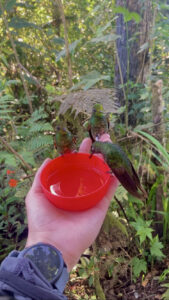
The most common and diverse animals we saw, however, were easily the birds. There were a wide array of tropical birds including toucans, trogons, and lots of hummingbirds. The hummingbirds, especially, were so unafraid of humans that if you held a cup of sugar water, they would just land on your hand to drink it!
Some hummingbirds on my hand in Mindo.
Some hummingbirds on my hand in Mindo.
My friends and I also would make our own trips to the surrounding areas outside of class. We took advantage of one three-day weekend to go down south and visit Baños, a famous tourist town located in a low river valley that led into the Amazon jungle. As a result, like Mindo, it was a much more tropical environment than Quito’s highlands and had a variety of things for visitors to see and do.
One of the biggest surprises to us was how inexpensive everything was – while we had expected a big touristy destination like Baños to be expensive, it was actually very affordable – our lodging, for example, was a hostel that cost less than $10 per night which was surprising, considering how nice the premises were.
Hiking in Baños
Overall, the start of this second month in Ecuador was filled with a lot of travel and adventure in a welcome change of scenery from the mountainous dry terrain of Quito. However, the real adventure is yet to come – the next course, focused on tropical ecology, will feature a week-long trip to the heart of the Amazon Rainforest.
After one week of Spanish classes, the “true” classes for our program in Ecuador began. While the Spanish classes had taken place the week before the official start of the semester, when we showed up to campus the next week it was completely packed! As someone in the ecology and evolution track, my first class was focused on Geographical Information Systems (GIS), a computer program that allows one to display and analyze data on maps for data visualization. It’s not an easy program to learn, but thankfully I had actually taken a GIS course at Linfield about 2 years prior so I was already familiar with the basics.
However, there’s more to a study abroad program than just going to class, and our group (there were 22 of us in total, across both my track and the other track, which was focused on marine ecology) made sure to make the most of our time in Quito outside of class and over the weekends.
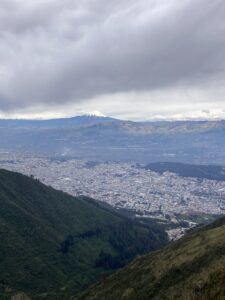
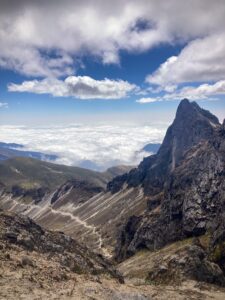
One of the first highlights of the trip for me was a climb up Rucu Pichincha, a 4,700-meter (15,400-foot) peak located immediately west of Quito. We accessed the trailhead by a cable car and proceeded to hike towards the peak. Fifteen thousand feet of elevation is no joke. Even though the trail itself was never particularly steep, the thin air wore us out quickly and 5 of the 8 people in our group ended up turning around before the peak. But the three of us who did make it up to the top were treated to a great view of not only Quito but also the mountains on the other side of Rucu Pichincha.
A view of the city of Quito from halfway up Rucu Pichincha. The Cotopaxi volcano is visible in the background.
The view of Quito from partway up the trail with Cotopaxi in the background (left), and the view to the west from near the summit of Rucu Pichincha, at about 15,000 feet.
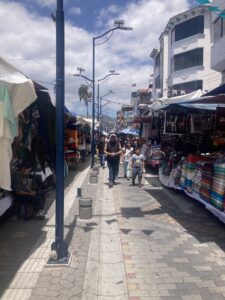
We also traveled a short distance to visit the town of Otavalo, located about 2 hours or so north of Quito. A vibrant center of the traditional lands of the indigenous Otavalo Kichwa people, Otavalo is famed for its Saturday market. On busy days, the market can spread across a third of the city and is claimed to be the largest artisan market in South America. It certainly felt like it, as the stalls seemed to stretch on forever, no matter where you went. People were selling various goods ranging from basic souvenirs to handicraft jewelry and clothing, to expensive artisan sculptures and art pieces. You’d be hard-pressed to not find anything you were looking for there.
The streets of Otavalo during the Saturday market, around the outskirts of the stalls (left) and in the central square (right).
Overall, I feel I am beginning to settle well into Ecuadorian life. The food is excellent, the people are nothing but kind and friendly, transport is cheap and easy to find, and the university is a vibrant campus with lots of student life. What more could you possibly ask for?
After more or less a full 24 hours flying from Honolulu to Los Angeles, then Panama City, and finally Quito, I have finally arrived in Ecuador!
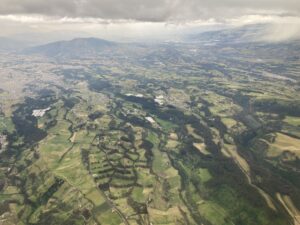
The approach into Quito
The Galapagos program, which I am participating in, is structured very differently from a typical study abroad program. Taking classes like any other student, we pick a “track” with a focus on a specific subject (mine, for instance, is focused on ecology and evolution). Each track includes five intensive three-week-long courses, taken one at a time with three hours of class a day.
Basically, it’s like five Jan Term classes all strung together. In addition, since the university here in Ecuador (Universidad San Francisco de Quito, or USFQ) doesn’t have any student housing, we don’t live in dorms or apartments but with host families who the university assigns us to.
In any case, my host mother picked me up from the airport and drove me into town. Host families seem to vary pretty widely in terms of size, income, and location, although as far as I can tell most of them are in the same neighborhood as the university.
I was lucky enough to live quite literally a block away from campus, so it might as well have been campus housing! My host mother lives alone but her children and grandchildren visit often, which I think is a good combination – you often meet other family members, but can still have peace and quiet if you come home after a long day.
Having arrived on Friday, I had the weekend to get to know the area before orientation and classes began on Monday. The university is located in Cumbayá, a neighborhood located about 30 minutes from central Quito. One of the highest-income areas in the city, it is very safe and has many malls, stores, and restaurants as well as many gated neighborhoods.
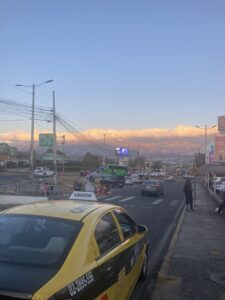
A view of Cumbayá at sunset
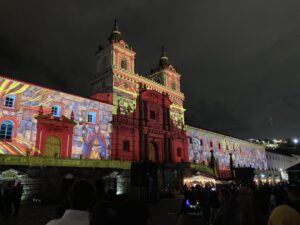
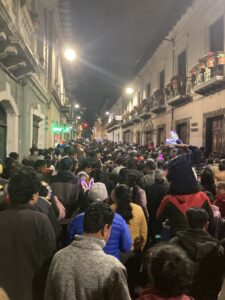
I had happened to arrive the day before Ecuador’s Independence Day, August 10th, so when Saturday came around my host mom took me with her relatives to observe the festivities. It was a good opportunity to see downtown Quito and try out the public transportation, although the streets were insanely packed.
The festivities of Ecuador’s Independence Day in Quito’s old town
After the weekend, classes and orientations began. While our courses were each three weeks long, our first week was a standalone Spanish course to ensure everyone could at least do some basic communication. The classes were split based on the results of placement tests we took prior to arriving, so everyone was in a class that matched their skill level.
We also had several orientations concerned with the rules of the program and life in Quito. We were given a tour of the campus, which is probably a 10th of the size of Linfield, taking up about 1 and a half city blocks. Despite this, it has nearly 5 times as many students, so it is extremely densely packed!
Overall, though, it is a great campus in an exciting area, in my opinion, and I am excited to get to know it better!
Ok, I know it’s actually merry Christmas, but after this trip, to my family, it will forever be merry chicken. There’s a lot to unpack from these last two weeks, both from my suitcase, and in this blog update, so get ready for a lot of randomness and cool photos that i stole from the two photographers of the family to use here. I’ll go in order and dedicate a section to each city we went to, so hopefully it shouldn’t be too hard to follow along.
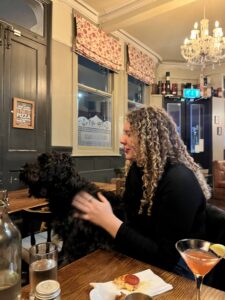
Our journey starts on December 18th when my family got to England. I met them at the bus station, and within 5 minutes, my mom had already gotten lost trying to navigate us to our hotel in Nottingham. We had a great dinner at a small pub right across the street from our hotel that had a dog. After 3 months with no dog, I finally got some puppy snuggles! We only spent approximately a day and a half in Nottingham, but I took my family around my University campus, to the Christmas market in the city centre, and to an experimental cocktail bar for dinner. Then on the 20th, we got up early to take a coach to London. By this point, everyone was pretty jet lagged and just a little bit snappy, so we tried to keep it as lowkey as possible.
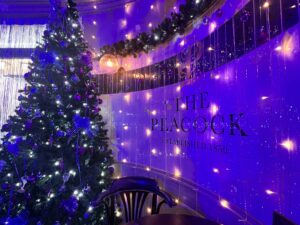
Clara and SparkleThe view from our table at the PeacockThe Alchemist for drinks and dinner on our last night in Nottingham
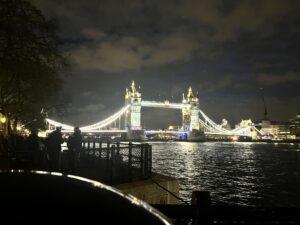
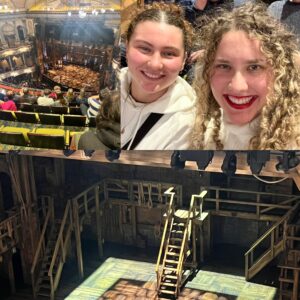
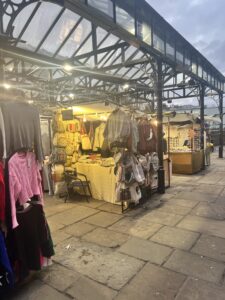
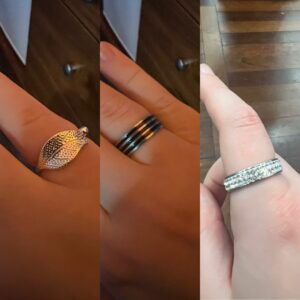
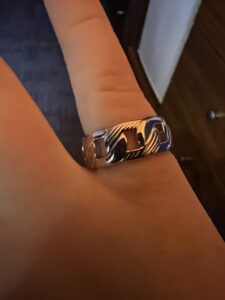
On to London! We arrived in the afternoon on the 20th, so it was already getting pretty dark. We dropped our stuff off at the hotel and took the tube into a more central spot in the city to walk around some Christmas markets and over a couple bridges. The next day was full of getting attacked by birds at Hyde Park and my mom, yet again, getting lost looking for landmarks. Then my sister and I split off from my parents because we went to two separate shows on the West End! My sister and I, like the true Americans we are, went to Hamilton, which was a truly amazing experience. The next day, my parents split off again to see all the tourist attractions they could while my sister and I took a more relaxed approach and went to Camden for the day to walk around the markets and have dinner. I found my London ring(s) at the Camden market, too. It is a really cool district within London and I’d highly recommend anyone who goes to London to stop over there for a little while. Our last day was basically spent waiting for our train to Paris. We stopped at a pub to have lunch. This is where merry chicken was born, but we were all so delirious that none of us can remember what the comment was for it. So, it will forever remain a mystery!
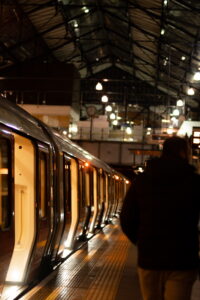
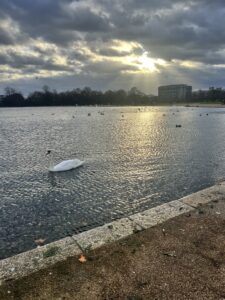
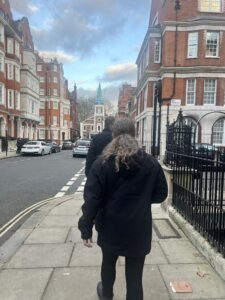
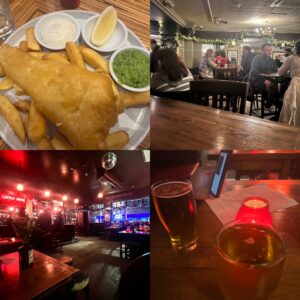
Views from our walk on night 1 in LondonJourney on the tubeHyde ParkParents cruising through the streets of LondonSome of the places we went for food/drinksHamilton NightCamden MarketLondon rings
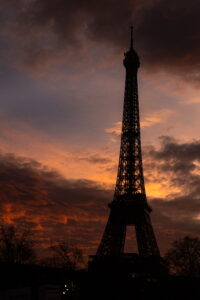
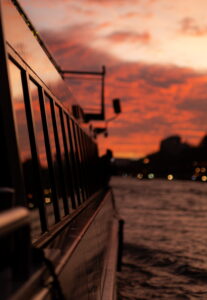
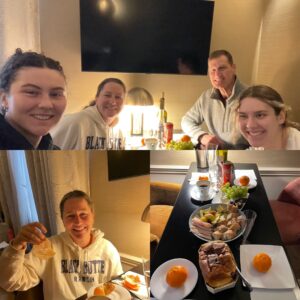
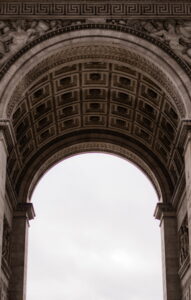
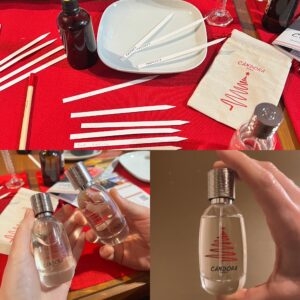
Next stop, Paris! We arrived in Paris really late on the 23rd after taking the Eurostar, so we crashed, but the next day was Christmas Eve! Christmas Eve was one of the coolest days of the trip. We walked up a street that had some amazing places to get pastries and cheeses, so we stopped there to pick up some food for Christmas morning, and then went on a Seine river cruise at sunset. Some of the most beautiful pictures from the trip came from my sister and dad on this boat, and that was one of the prettiest sunsets I’ve ever seen.. Before we knew it, we were clinking glasses and saying Merry Chicken the next day! We had a very chill day on Christmas because few places in Paris are open on Christmas, so we opted for a breakfast in our hotel room with the food we picked up the day before, a walk to the Eiffel Tower, and a relaxed dinner. It was definitely a different Christmas than what I’m used to, but one of the best I’ve ever had. The day after Christmas was one of my favorite days of the trip, because my sister and I took a class on creating our own perfumes at a perfumerie in Paris! The atmosphere of the room felt very regal and we had a full immersive lesson on different smells and how to mix and match ones to create a scent we really liked to take home with us. Definitely a great last full day in Paris.
The view of the Eiffel Tower from our sunset cruise on the SeineOur cruise boat reflecting the beautiful sunset.
Christmas Day walk to the arcPerfume making class
Brussels was next on our trip, and this was definitely an experience. We stayed in an area off the center of the city, so we were all definitely a bit more cautious as we were walking around that area, but when we arrived in the city, we were able to visit some really fun areas.
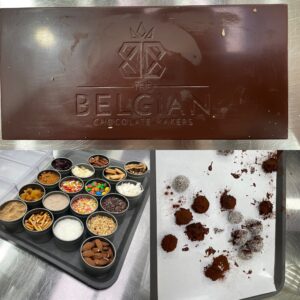
Our first full day was full of chocolate. We attended a Belgian chocolate making class where we made a chocolate bar, some traditional Belgian chocolate circles, and truffles. As a baker, this was like a dream to me, and I had so much fun learning how to work with chocolate in a commercial space. My mom, however, was a little newer to the experience of working with chocolate and may have “killed” a few of her truffles.
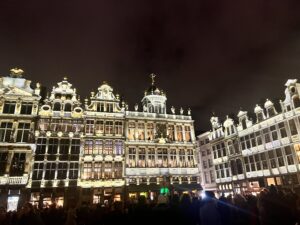
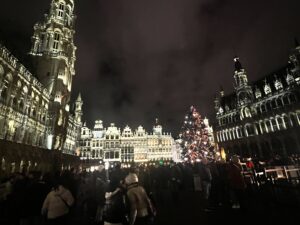
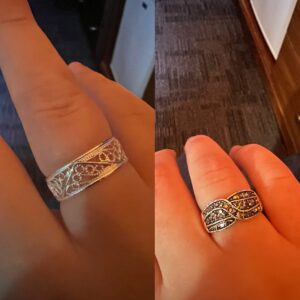
Once we were done with that, we walked around one of the Christmas markets in the city center and I found two Brussels rings as well as a beautiful treble clef necklace. We also caught a light display of native art projected on buildings in the city center which was incredibly beautiful, especially as the sun began to set more. Our final day in Brussels, we went to the Atomium and had a bird’s eye view of Brussels along with another display of lights inside the museum. As a blind girl, colored light displays are one of my favorite things ever, because they’re like glowing, moving art that I can experience as much as a sighted person could experience a normal art museum. That was a great way to end our visit to Brussels.
Some of the cool light displays in BrusselsLighted building in the city centreBrussels city centre square decorated for christmasOur chocolate making class, featuring my chocolate bar and Laura’s “killed” trufflesBrussels rings
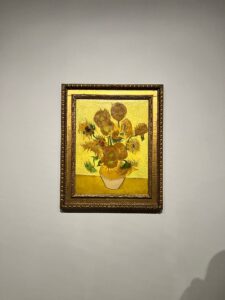
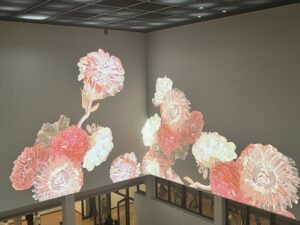
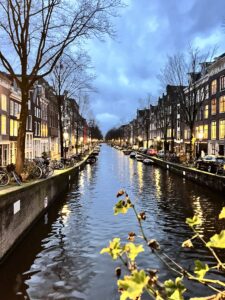
Our final stop was Amsterdam. Amsterdam is a really cool city and our hotel was right on one of the canals. This hotel was also the most livable space for 4 people of all the places we stayed on our trip. Our first day in Amsterdam, we went to the Van Gogh museum. I know, I know, I just got done saying how I like light shows more than traditional art museums, but this was a great museum, and even though I couldn’t see as much detail as a fully sighted person would, I could still see the paintings and have a member of my family read the description/backstory of the art to me. It was like my own personal audio tour!
My sister, who is a very gifted artist herself, was really in her element at this museum and it was fun to watch her just wandering around taking it all in.
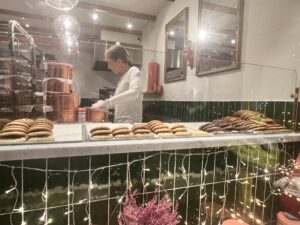
Then, before we knew it, it was New Year’s Eve! My mom and sister went to the Heineken experience while my dad and I explored The 9 Streets, which are a collection of streets that have a lot of local Dutch shops showcasing the culture of Amsterdam. We went into a couple of stores including one vintage store where I got my Amsterdam ring! My mom and sister met back up with us and we went to get some dinner before going back to our hotel to play cards and “enjoy” some fireworks for the rest of the night. Why air quotes you ask? Because they were being lit off right next to our window and scared my mom half to death. And they lasted a full 2 and a half hours until about at least 1:30 in the morning. New Year’s Day felt a little like Christmas in that a decent amount of places were closed and we ended up just wandering a bit and looking at the Amsterdam light festival before going to get some dinner. Our last day was more of the same except this time it was pouring down rain, so by the time we went to collect our suitcases and go to the airport to fly back to London, we were absolutely soaked. But we made it back to London and my parents flew out to go home the next morning.
Painting hung in the Van Gogh museumDigital projection at the Van Gogh museumAmsterdam canalAn art installation at the Amsterdam festival of lightsCookie store in Amsterdam’s 9 StreetsAmsterdam ring
I feel incredibly blessed that I was able to go on this trip and my family was able to come over and spend the holidays with me in so many wonderful places. I was a bit nervous that we would be at each other’s throats or absolutely exhausted at about the halfway point, but we wasted a full 18 days without any major arguments, and had a good amount of downtime and a LOT of laughs. Now, I have about 3 and a half weeks until I go home, which feels both like a really long time and not much time at all. I have a couple essays to write but for the most part I just get to exist in the culture for a little while until I go home.
Yes, this was long, but, it was also a long trip, and I didn’t include half the experiences we had as a family for the sake of your time. For those who made it to the end, though, I hope you enjoyed a glimpse into how my family travels, and to my mom, dad, and sister, who I know are reading this, thank you for making my holidays amazing and I love you.
That’s it for now! I’m finished with my class essays, and now I just have a bit of my own work to do before one of my friends arrives and we spend my last week traveling one last time before I go home. I hope everyone had a very merry chicken and happy new year!
It’s that time of year when everyone is simultaneously getting all festive for the holidays and also feeling like everything is going wrong, and I am definitely no exception to that. The last two weeks have been a whirlwind of good and bad, busy and slow.
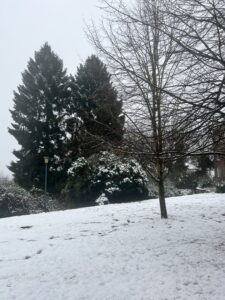
Let’s start with the negatives so we can end on a positive note. Most of the negatives came from, essentially, a game of whack-a-mole with problems in my room. This all started about a month ago when my entire hall lost heat. We thought it was just going to be a couple days, but it turned out to be 3 weeks! The weather was a range with the highest reaching only about 45 degrees (f), and the low being below freezing at about 25 degrees with snow (beautiful, but when you have no heat it makes it a bit harder to enjoy to the fullest extent).
View of snow from my window
Needless to say, one day I went to the city centre to stock up on blankets, gloves, and scarves to try to keep myself warm, and big shout out to one of my friends for graciously gifting me her hot water bottle to keep myself warm. Anyway, that was finally last week, but we’re not done! I then found mold in my shower (not ideal), so luckily my welcome point was quick to get someone out the same day to get rid of it. Then I had an issue where my fridge door wouldn’t close because there was too much ice buildup in the freezer section. Again, my welcome point was quick to get someone out to chisel some of the ice off for the door to close, but just my luck that all of these problems were happening basically all at once.
Most of these last few weeks have been filled with schoolwork and other work. These past two weeks were the last two weeks of classes!. I finished my last in-person seminar on Thursday, the 14th of December, and all I have left is my final essay for each module I’m taking. I’ve already completed 2! One to go, but that will have to wait until after the holiday break (I have some big plans for the next two weeks, updates on that in a bit). It feels good to have most of my work for my modules done before the holidays as I won’t be thinking as much about the amount of work waiting for me on the other side of the break. I still have one essay, but that’s a lot less daunting than 3.
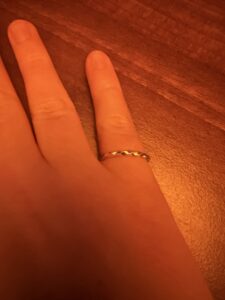
Some other random updates, I went to see a movie with my friend Aki on Sunday, the 10th of December. Yes, this is the second time I’m reviewing a movie on this blog; maybe I should just turn this into a movie review blog ;). Anyway, we went to see Saltburn, and it was one of the weirdest movies I think I’ve ever seen, but it was really well done and I’d definitely recommend it to anyone who likes psychological thrillers or movies that have some sort of societal commentary in them. After the movie, I finally picked up my Nottingham ring!
Also, on Wednesday, I had my last lecture for one of my modules, Producing Film and Television, with one of my friends, Angela. She is from Taiwan and wanted to introduce me to hot pot after I told her I had never had it before. So, once the lecture was done, we made a quick trip to a couple different stores to pick up some ingredients and then she graciously made me a delicious hot pot to celebrate the end of that module. On the subject of me thinking about what is going to happen when I come back in January, I found out where I’ll be living for spring term! I’ll be sharing an on-campus apartment with my good friend, Lizzie Arnold (she just finished her study abroad in Austria and blogged about it, so check out her posts if you’re interested). I can’t wait to be back on the Linfield campus and to be living with one of the best people I know.
Aki and I after the movieNottingham ring
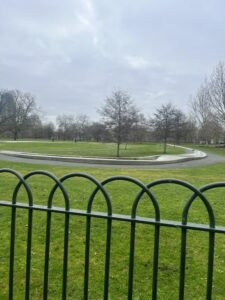
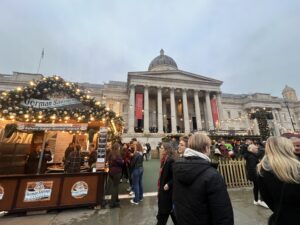
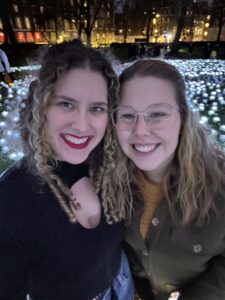
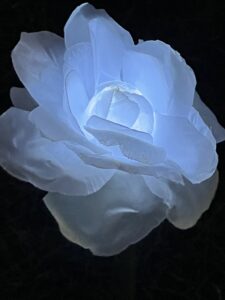
I also received a fun surprise – one of my cousins and her husband were, on short notice, coming to London for a few days! So, on Friday, I woke up at 4:45am and took a 6am coach down to London to meet up with them. It was mainly just my cousin and I, and we walked all around Hyde park and the Princess Diana fountain before heading to a couple of smaller Christmas markets. Once it started to get dark, we went to this pop-up called the Ever After Garden with glowing white roses and it felt like a fairy tale. We topped it off with a delicious dinner with gochujang chicken lettuce wraps, dumplings, peanut chicken skewers, and duck curry. I’ll be thinking about that meal for a while and the restaurant ambiance was so cool.
Then, I said goodbye to my cousin and her husband and hopped on a coach back up to Nottingham; 12.5 miles (27,500 steps) later, and I absolutely crashed right when I returned to my hall. It was so great to see them though, and it makes me excited when people who are visiting have the same joy for the place where I’ve been living for a little while.
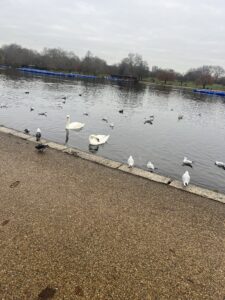
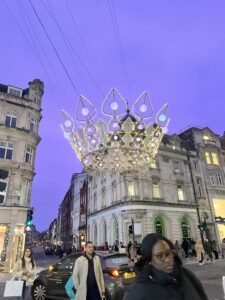
6am coach rideSo many birdsPrincess Diana FountainA small London Christmas MarketWho wouldn’t think a light crown is cool?Lena and I at the Ever After GardenA close up of the rosePart of our amazing dinner
I am definitely starting to miss my family, but that won’t be an issue for very long as they’re arriving in Nottingham TODAY!! We have a very big trip planned over the next two weeks. From Nottingham, to London, to Paris for Christmas, to Brussels, to Amsterdam for New Year’s, and back to London for another day before I head back up to Nottingham for 3 more weeks and they fly home to Oregon. So, for those of you who like my blogs about going places, you’re in for a treat with the next update.
That’s all for now! I’m still having an amazing time, and I’m happy to have all my lectures and seminars done so I have more time for other experiences in Nottingham and beyond. Stay tuned for a hefty post with lots of travel updates in the next couple of weeks!
If you came here for a post full of pictures of the amazing places I’ve travelled to, you’ll be disappointed (not entirely, I’ve still been to one or two other places). But, for the most part, this post will be a more reflective style blog that focuses on my feelings toward this time and what I have learned so far seeing as I’m about halfway done with my time here.
But first, for those of you that enjoy hearing about the places I’ve been and the things I’ve been doing, let me fill you in on all of that.
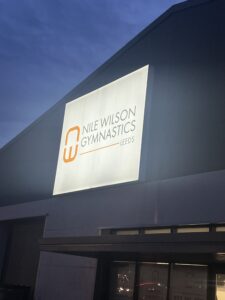
On Sunday, 26th of November, I had the opportunity to go up to Leeds to help with an event at a gymnastics club. It was a fantastic experience and it was so fun to watch the pure joy as young kids tried gymnastics for the first time. It was an early wake up time for me at 3:15AM but it was very much worth it.
Entrance to Nile Wilson Gymnastics Leeds
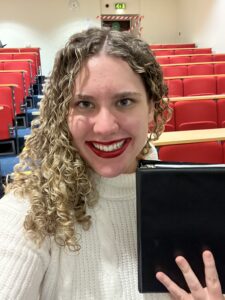
I also was able to do another online speech and debate tournament with linfield. It was another couple of late nights holed up in an academic building until 4:00AM but I had a great time debating with Ally, my debate partner, and competing in prose interpretation and program oral interpretation. Ally and I placed 2nd twice, 3rd once, and 4th once. We didn’t make it to finals but considering it was only our second time debating together, we performed very well and our speeches were solid. The speech side was also very fun and I ended up placing 2nd in prose interpretation! This tournament was a bit harder to wake up from and really messed up my sleep schedule but hopefully I can get it back on track soon.
Debate nightSpeech night
Now for some reflection.
As I said before, I’m halfway through this journey and have come to realize a few things about what this study abroad is for me. The first is that this is almost an alternate universe in a way. I get to see what my university life would have been like if I had chosen to go to a big university instead of Linfield, or if I had chosen to go to a university outside of the country instead of Linfield, and I get to see all of that for 4 months and then I get to go back to the life I chose. I can’t imagine my life without all the people I’ve met at Linfield, but this time abroad really makes me think about the fact that if I had chosen a different path than what I did, I wouldn’t have met all of the people I met when I chose to go to Linfield.
I also have reflected on the idea of homesickness while abroad and if I’ve felt it at all. And I can honestly say I haven’t felt nearly as homesick as I expected to feel at all. The first couple of weeks here I definitely felt out of my element and missed the security of the cities in Oregon that I’ve come to feel comfortable in, and every now and again when I think about someone that I miss from home or I text someone that I miss from home it will make me wish that I was back there to talk to them in person. But overall, I’ve embraced this time as a time to really understand the culture of the people I am living with and appreciate the differences I’ve noticed.
A lot of those differences have to do with a focus on community. People here place a much higher value on connection and spending time with each other: whether it’s going out to bars, grabbing a coffee, going home to spend time with family, or even just asking to hang out in each other’s rooms/houses. That’s in fairly stark contrast to the US where we place a higher value on things like work and productivity. There is still a focus on that here, but taking time to relax and spend time with people you care about, is of equal importance here and that is something I’ve really enjoyed.
Another difference that’s definitely been at the forefront of my mind is the academic schedule. The US has a very participatory approach to education where your attendance is marked and you have assignments/tests throughout the semester to monitor your retention and understanding of the material you are learning. Here, your attendance is checked, but it doesn’t count towards your overall grade, and your grade is based on (at least for all my classes) one essay that is turned in at the end of the semester. Needless to say the next couple of weeks for me will be filled with a lot of research and writing.
Overall, as I reach and pass the halfway point, I’m in a kind of weird state where I feel like I simultaneously have a lot of time left, and also feel like I should be almost done and ready to head home. I do miss seeing all of my friends and family and I miss some of the US culture that I love, but I’ve also really enjoyed getting out of my comfort zone and exploring more of the world than I ever thought I would in a span of 4 months.
Over the next two months I hope to finish out the semester well with my essays being good quality work that I can feel proud of. I also want to get as much time in with the new friends I’ve made as possible because I don’t know when I’ll be able to see them again. Through things like societies and classes, plus just sheer coincidence, I’ve come to form bonds with quite a few people here and it’s weird to think that in two months, I’ll be on the other side of the world from them.
I’ll never take for granted how much I’ve been able to do and see throughout this trip, and I will make sure I get as much out of the next two months as I possibly can.
Well, that’s it for my philosophical ramblings and sentimental reflections. See you back here in a couple weeks for my end of school semester thoughts and maybe some more travel stories.