
Our second main course was focused on Tropical Ecology, and our new professor’s approach was a very hands-on. In his opinion, the best way to study a complex tropical ecosystem like the Ecuadorian Amazon, was to go there ourselves and observe it in-person. So that was exactly what we did – spending five days deep in the Amazon rainforest, miles and miles from any major city. It was so isolated that even reaching our field station took an entire day!
Our journey began at the Quito airport, where we took a 2-hour flight over the eastern cordillera of the Andes to a city known as Coca. From there, we embarked on a small motorboat that took us about 40 kilometers down the Río Napo. Due to a drought in the area, our captain had to navigate shallow waters that made the journey take an additional two hours. We then disembarked at an oil drilling company’s base camp. Oil drilling is a major subject of debate in the Amazon, as it is a big part of Ecuador’s economy, but is obviously very destructive to the environment.
From the oil company camp, we rode by bus, which took us down an access road for another 50 kilometers and 2 hours (the road was unpaved and very windy) through the jungle. We then took yet another motorboat which took us the last 50 kilometers down the Río Tiputini to USFQ’s Tiputini Biodiversity Station, 3 hours later. After a full dawn-to-dusk day, we arrived at our destination. There was no road, settlement, or infrastructure for miles. Coca, the nearest major town, was now over 60 miles away.
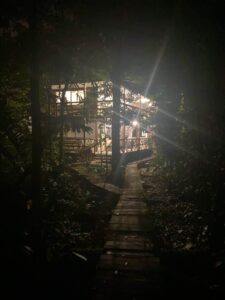
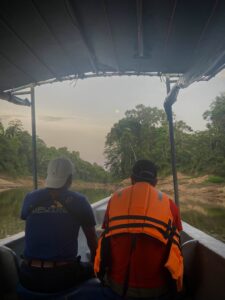
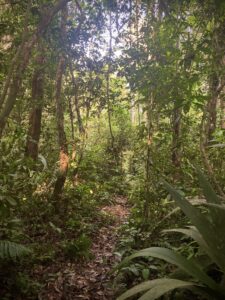
The next day, we went into the jungle. We spent the first day hiking and simply observing the incredible jungle, to get accustomed to the terrain, climate, and wildlife. As someone who grew up hiking in the jungles of Hawai’i, I thought I knew humidity, but nothing compares to the Amazon. It was so bad that during our downtime, we would turn on the generator and sit in the lab, the only building with A/C, for hours.
The dense jungle foliage and multitude of dangerous spiders and insects were also a cause for concern, making hikes generally a strenuous experience. However, it was well worth it in the sheer variety of wildlife we saw – from tropical birds like macaws and the hoatzin to simians like the squirrel monkey and golden-mantled tamarin to aquatic mammals like the capybara and giant river otter. We even found prints from a jaguar, but never saw the animal itself. And, of course, there were countless insects from giant centipedes to the infamous bullet ant.
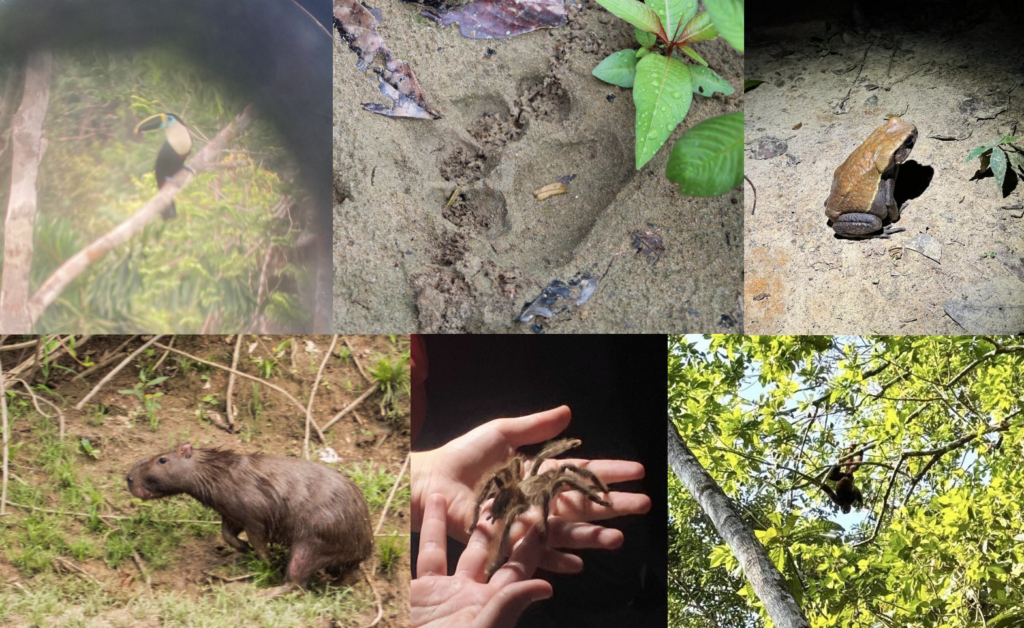
A small (blurry) collage, moving clockwise: a white-throated toucan, jaguar print, giant toad, capybara, tarantula, and howler monkey.
Our later days were focused on interactions between indigenous peoples living in the Amazon and the “outside world”. Many of the Amazonian tribes have only recently been connected to the industrial world (two tribes even remain uncontacted), which has led to many negative interactions with Ecuadorians. These range from personal disputes between tribespeople and outsider hunters and fishermen to manipulative contracts and agreements made by oil companies to allow drilling on tribal territory, with little given in return. To further augment our understanding of the local peoples in the area, we visited a nearby indigenous village that had been connected by a road about 10 years prior.
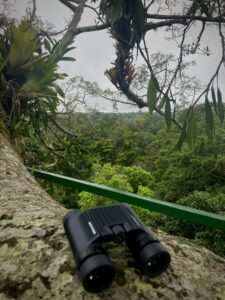
At the end of our stay, we had a lot of time to reflect on our experience during the long journey back home. While we were only in the Amazon for about five or six days, it was genuinely a life changing experience that will stick with all of us for a long time.
Kai