After seven weeks on the Ecuadorian mainland, it was finally time for us to transfer to the Galápagos, where we would spend the remaining ten weeks of the semester. USFQ’s Galápagos campus is located on the island of San Cristóbal, the second most populous island in the archipelago. To get there, we took a flight from Quito direct to San Cristóbal with a short stopover in Guayaquil to pick up some additional passengers.
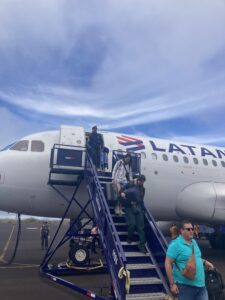
Disembarking at San Cristóbal.
My first impressions of the Galápagos, upon arrival, reminded me in some ways of the arid parts of Hawai’i, where I grew up and still live; the mix of low, dry vegetation with rocky shores and sandy beaches was similar to parts of O’ahu in the dry summers. However, there were two major differences that were immediately apparent; first, the lack of mountains and second, the extent of human habitation.
San Cristobal is estimated to have a population of around 7,000 people, the vast majority of whom live in a single town, Puerto Baquerizo Moreno. While that might still sound like a lot of people, consider that McMinnville has a population of around 35,000. So Mac – which most people probably wouldn’t consider to be a very large town – has around five times as many people as the entirety of San Cristóbal!
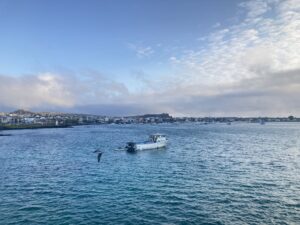
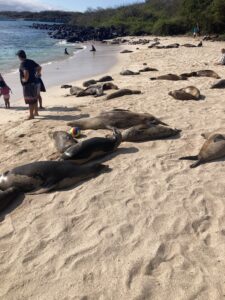
Obviously, though, this is to be expected – after all, the Galápagos is famous not for any big towns and crowds but rather for its wildlife and natural environment. And indeed this was also evident; for instance, we encountered sea lions almost immediately after arriving, laying about on the beaches and even in the streets in parts of town close to the shore. While I’ve seen seals and sea lions in the wild before, the sheer number that were sprawled out on the beach was shocking.
The USFQ campus is located on the northern end of town, right in front of Playa Mann, the town’s main beach. Like in Quito, we all lived with local host families; this time, I lived with a family of four. The environment there was really different from my host experience in Quito, but it wasn’t a bad change. While we had the weekend to re-orient to life on the islands, when Monday came around, we went right back to work to take our first Galápagos classes.
Kai