Deprecated: Function WP_Dependencies->add_data() was called with an argument that is deprecated since version 6.9.0! IE conditional comments are ignored by all supported browsers. in /chroot/home/a1e0f025/dab19c68f8.nxcli.io/html/wp-includes/functions.php on line 6131 Deprecated: Function WP_Dependencies->add_data() was called with an argument that is deprecated since version 6.9.0! IE conditional comments are ignored by all supported browsers. in /chroot/home/a1e0f025/dab19c68f8.nxcli.io/html/wp-includes/functions.php on line 6131

A Lovely Homestay in Rabat

Salam from Rabat, Morocco! 

Tonight is our last night at our homestay, which is bittersweet! Our host mom, Leyla, has been so incredibly kind and welcoming to us. We were split into pairs and divided among several homes. We have been fortunate enough to spend three nights at our homestay, which is not even close to enough time to integrate into and understand the Moroccan home, but for the length of this course, this time was so precious and important! We had three host siblings, a 22 year old boy in university, a 20 year old girl, and a 14 year old boy. Of course, I also can’t forget, our host cat, Queen! Queen was a beautiful white cat with one blue eye and one brown eye! Our host sister, Imman, took us out on the first night to walk through the médina and explore. I was amazed at how well she was able to navigate her way through the complicated street layout of the médina, but she told us that she has lived in the médina her entire life, and still gets lost sometimes!
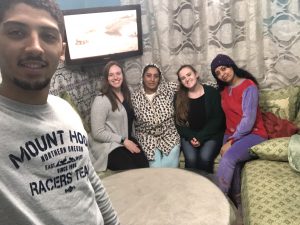
My wonderful host family in Rabat, Morocco

Our host mom made us full breakfasts with different types of bread, cheese, jam, tea and coffee, and olives. She also served us a full spread for tea, which is between 4:00 and 7:30 every afternoon. By the time I’ve had tea, it feels like a late dinner for me, and I’m full, but dinner always comes even later, around 9:30 in the evening! We had delicious chicken tagine one night, soup and potatoes another night, and then spaghetti with chicken! Moroccan families share one big plate, and eat off of it with bread, forks, or just their fingers. It’s a great strategy to have less dirty dishes!  Each night, we would watch TV, usually American movies in English, with Arabic subtitles, and our host siblings and mom would use their phones, which felt very much like home. It was casual, comfortable, and normal! The TV is also always on in Moroccan homes, but it’s not as distracting as you might think! It’s more like background white noise. 
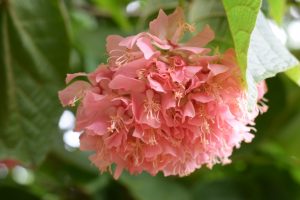
Beautiful flowers in Rabat, Morocco

On our second night in Rabat, we went to a hammam, or public bath. It was an experience we were told was a necessity on a visit to Morocco! It was a very interesting experience, and a great normalization of all types of human bodies. This isn’t something that I usually experience in the United States. I was very nervous, but at the end, I don’t regret going, and I’m so glad to have gotten to experience this aspect of Moroccan culture—and my skin is really, really soft! 
Raindrops on leaves in Rabat, Morocco. It rained when we first arrived, but then cleared up for a lovely last few days!

In Rabat, we visited some local sites that are must sees! We visited Chellah, Roman ruins in Rabat. The ruins have public bathhouses, which tell an interesting story of a transfer of culture: the Islamic people were inspired by Roman bathhouses, and now, bathhouses are an important part of Islamic culture. The ruins also have mosques, built during Islamic occupation of the site.
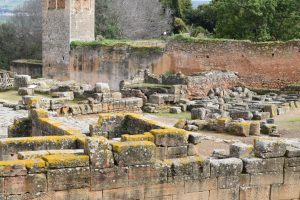
Chellah Roman Ruins in Rabat, Morocco

We also visited Hassan II, a royal mausoleum where the late King Hassan II, and his father, the also late King Mohammad V, are buried. There is also the remains of a mosque that was started by the Almohad dynasty in Morocco, but was never finished. 
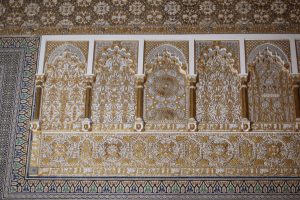
Inside the Hassan II Mausoleum in Rabat, Morocco

On our final day, we presented our final takeaways from the course, which was a really valuable exercise, and I have seen a lot of growth in myself, as well as my classmates.
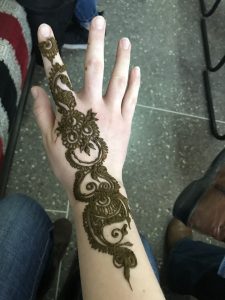
Beautiful henna art in Morocco, as part of the goodbye programming

We finished the day with a visit to a beautiful beach, where we were just across the Atlantic from Myrtle Beach, South Carolina! I found a lot of beautiful sea glass, which we were allowed to take with us as a souvenir.
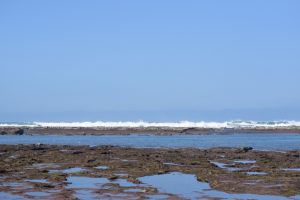
A beautiful beach in Rabat, Morocco

We ended the day with some shopping in the médina! I bought spices, which I am really excited to use, as I love to cook. I also got a few gifts for my siblings. I enjoyed experiencing the médina with local students, because they were able to make the situation a lot less confusing! It is hard to not be able to speak the language of a country, which makes me remember the privilege I have as an English speaker in the United States! The patience that Moroccans have with all of us reminds me how important it is to take an example from their patience and enact it in my own life. I am looking forward to the “language comfort” I have in Spain, where I am able to communicate in Spanish. 
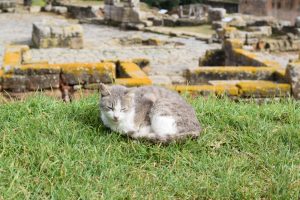
There are cats everywhere in Morocco! They don’t usually want attention, they just sit and watch!

Morocco has been an amazing experience, and I feel so lucky to have been able to spend so much time in this country, and even get to stay with a host family! I have absolutely loved being here. Unfortunately, I have been feeling a bit sick these past few days, I think from the odd eating schedule (for me!) and insane volume of food at Moroccan meals, but I was able to use Google Translate tonight to communicate with my host mom that I wasn’t feeling good. This reminded me of the importance of advocating for yourself, even if it’s difficult, or you need a little bit of technological help! I am so appreciative of how kind my host mom has been to me to help me to feel comfortable and better! 

There’s no reason to feel bad about using Google Translate sometimes, especially if you need to say something specific!
There’s no reason to feel bad about using Google Translate, especially if you need to say something specific!

Shukraan (thank you) for traveling along with me through Morocco! Now, back to Spain!

Emmaline
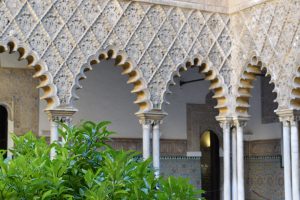
Granada: The Last Muslim Kingdom

Hola from Granada, Spain!

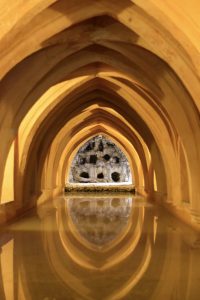
We have had a busy few days! We took a day trip to Sevilla from Córdoba, where we saw the Real Alcazar, or Royal Palace, modeled after Granada’s Alhambra. I loved visiting Sevilla and seeing the Real Alcazar was a great preview to the Alhambra’s power and influence.

Arabic architecture at Real Alcazar in Sevilla, Spain
Pools in the garden of Real Alcazar in Sevilla, Spain

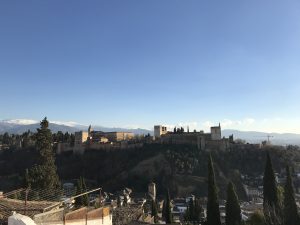
We arrived in Granada 3 days ago, and we have been moving around like crazy! On our first day, we climbed a giant hill to Plaza San Nicolas, where we were able to hear some live music and get a great view of the Alhambra and the Sierra Nevada mountain range behind it. The mountains surrounding Granada were part of the reason that it was so isolated and able to survive as the last Muslim Kingdom in the Iberian Peninsula until 1492.

View of the Alhambra from Plaza San Nicolas

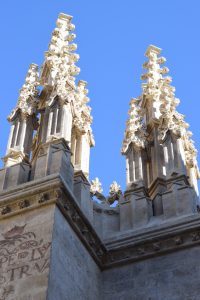
On the second day, we visited the Capilla Real, or Royal Chapel, which is next to the Catedral de Granada. The Capilla Real is where Ferdinand and Isabelle, the Catholic Monarchs who captured Granada are buried. Originally, they wanted to be buried in Sevilla, but after conquering Granada, they decided to move their burial site. The chapel was not even close to completion at the time of their deaths, so they were buried at the Alhambra until the chapel was finished by Carlos, their grandson, who inherited the throne. Juana, the third daughter of the Catholic Monarchs, and her husband Felipe, Carlos’ parents, are also buried in the chapel, along with another grandson of the Monarchs, Miguel, who died when he was three years old. Photos were not allowed in the chapel, but it was incredibly beautiful. 

A portion of the facade on the Capilla Real

Later in the day, we got to visit the Alhambra! I was so excited to visit, and this site did not let me down! The Alhambra was originally a military fortress that dates back to the 1100s, and this military district of the Alhambra is still standing today. The Nasrid family established their dynasty in Granada after making a deal with Christian rulers: they would help the Christians take Córdoba from the Almohad Muslims, but the Nasrids would get the Kingdom of Granada as a protected area. The Nasrids were Muslim, but did not like the control of the Almohads. The Kingdom of Granada lasted from the 1200s to 1492, when the Catholic Monarch conquered it. They were in an isolated, defensive position, and also paid a tax to the king in order to maintain their protected status. In the end, Granada was weakened as Christian troops closed in. Isabelle felt that she needed to justify her power, and a military victory, especially one over the Muslims, would do just that. Granada also became unable to pay their tax, as it was paid in gold, and they traded silk into Africa for gold, and the silk industry had crashed. 

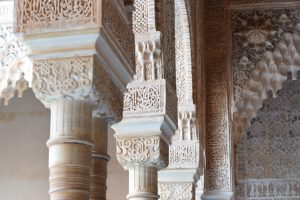
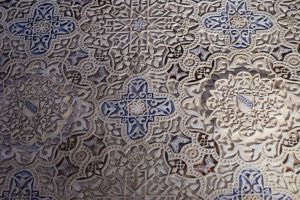
Arabic art and architecture at the Alhambra

The Alhambra’s construction began in the 1200s and was not completed until several generations later. The splendor of the Alhambra proves that the process was necessary and worth it. The decoration in the Alhambra can be described as “mural poetry.” In Arabic architecture and art, there are three main elements: writing, plant symbols, and geometric designs. The Alhambra features all of these, but writing is especially important. The motto of the Nasrid family is written everywhere in the Alhambra, roughly translated to “There is no victor but God.” I got really good at recognizing this phrase!

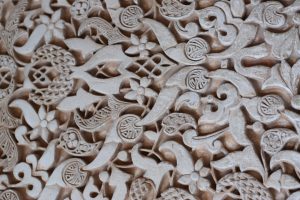
Stucco work at the Alhambra featuring the Nasrid motto, “There is no victor but God.”

When the Catholic Monarchs captured Granada, the only thing they changed about the Alhambra complex was the building of a cathedral over the Alhama (main) mosque. Later, Carlos built (and did not complete) a palace at the site, after he spent 6 months there on his honeymoon and liked it so much he wanted a palace. This was just one of many projects that Carlos started and did not complete. Carlos was the fifth Holy Roman Emperor, and the first Carlos to rule Spain, so he is seen depicted as both Carlos I and Charles V. I can assure you that this is incredibly confusing to all of us trying to figure out and memorize the history. He wanted to reproduce what Augustus was able to do at the beginning of the Common Era, when he ushered in the Pax Romana, however, Carlos spent a lot of time fighting while he was in power, so he didn’t quite achieve his goal.  

One of many empty spaces in Carlos’ unfinished castle at the Alhambra. Sculptures should have been placed here, but never were.

The Catholics did not alter the Alhambra, despite it being very distinctly Muslim, and of their enemies. Arabic art and architecture had been in style for many years, and it still was. The Catholic Monarchs realized the luxury and style that the Alhambra offered, and despite having Arabic writing all over it, they did not change this. The Catholics wanted to unite society under one religion to create more legitimacy as rulers and have a stronger bond of loyalty with their citizens. However, the Arabic style of the Alhambra was also the ultimate prize of capturing the last Muslim Kingdom. At the time, the line between Christianity and Islam was not as clear as it is today. The Catholics saw the motto of the Nasrids and simply translated “Allah” to “God.” This is much different than the attitudes of today, so it can be a little difficult to wrap our minds around! 

Stucco work at the Alhambra

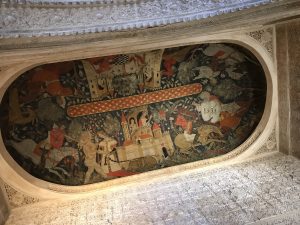
Islamic religious art cannot contain iconography, so we rarely see any sort of images of people or animals in these structures. However, in the Alhambra, the Muslim king had three paintings made that clearly show iconography. These paintings are in his personal space, so the iconography is allowed. They look like Christian paintings, but the people are Islamic. These paintings are great examples of how Christian culture permeated Islamic culture. We know that the Christians loved Islamic art and architecture, but the influences went both ways. 

Painting depicting Christian influence on Muslim art

After touring the Alhambra, we visited the Generalife, or Almounya country house. This house was located a bit above the Alhambra on the mountain, and it was a summer retreat for the King. It had gardens and fruit orchards, as well as easy access to the mountain to go hunting. This structure also had a great view of the Alhambra, and was beautiful in its own right! 

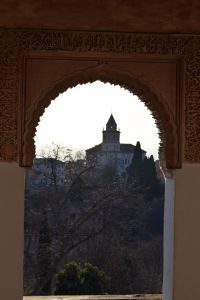
A beautiful view of the Alhambra from the Generalife

I have really enjoyed visiting all of these important historical sites in Granada. This is our last city in Spain before we travel to Morocco! I am excited to continue our journey as we learn more about the connected history of these two countries. 

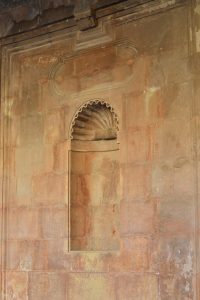
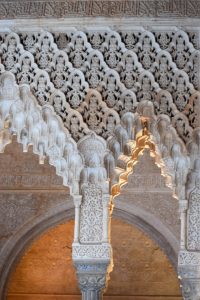
Arches typical of Arabic architecture at the Alhambra

Thank you for following along! 

Córdoba: Oranges and Abd al-Rahman’s Alhama!

Hola from Córdoba, Spain! 

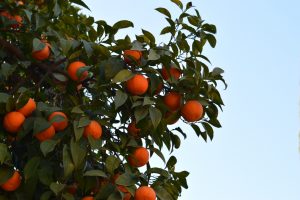
On Monday we drove about 4 hours from Toledo to Córdoba on a bus. All along the road were olive trees, which made it a beautiful drive! Córdoba is amazing. We are staying right next to the mezquita (mosque), and we can see down the hill across the river. There are orange trees everywhere with oranges on them!

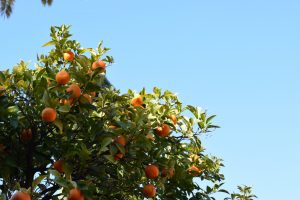
There are beautiful orange trees everywhere! They are edible but very sour, so it was recommended that we do not eat them. That must be why the trees are so full!

On Monday afternoon, we had a walking tour of Córdoba, which was really interesting. I always love going on walking tours because I feel like it is a great way to see the city and it doesn’t move too quickly. We got to walk through some of the main areas of the city and down by the waterfront. 

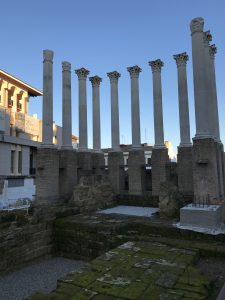
These remains of a Roman temple were pointed out on the walking tour. Córdoba has a long and rich history!

The mosque’s construction began in the late 700s by Abd al-Rahman. Abd al-Rahman escaped Damascus as a young man, and as a member of the Umayyad dynasty, his family was being massacred, and he managed to escape. The Muslim land of al-Andalus (what we now think of as the Iberian Peninsula) was where he sought refuge, as it was about as far as he could get from Damascus.

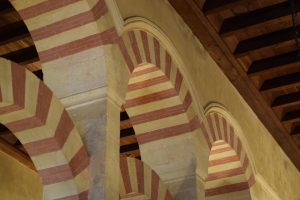
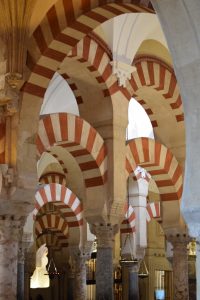
The stunning red and white colors are made of red brick and white stone. The alternating materials were used to strengthen the mosque structure, as well as to create a decorated arch.

He longed for his homeland, and this shows in his design of the mosque. Abd al-Rahman’s original mosque was smaller than what we visited today, as additions were made by subsequent rulers. The original mosque was made up of 11 naves, running north-south. The qibla wall of mosques is the wall that everyone faces to pray, and there is a niche called the mihrab where the leader of the prayer sits, and their voice is amplified through the mosque. The qibla is meant to face toward Mecca, so from Córdoba, this wall should face east, however, the qibla here faces south. This is because Abd al-Rahman wanted to recreate as much of his homeland as he could in al-Andalus, and mosques in Damascus face south. I think this is one of the really interesting facts about this mosque!

At its largest, the mosque had over 1000 columns. After the cathedral was added, there were less than 850 columns remaining.

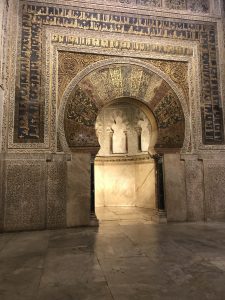
Over time, the mosque was expanded 2 more times in the southern direction, and then was expanded once more in the eastern direction. This last addition added 8 extra naves to the original 11, which puts the mihrab off center. However, the mihrab of this mosque is absolutely beautiful, and while off center, I am so glad it was preserved and not moved, as it is made of mosaics from the Byzantine empire. Byzantine artists were hired and sent by the government from Constantinople to Córdoba to complete the decorations on this mihrab. Nothing compares to seeing it shine in person!

The stunning mihrab with Byzantine mosaics! The picture doesn’t capture how beautiful and shiny it is.

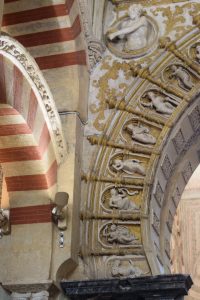
As you walk farther into the mosque, suddenly, there begins to be Christian imagery, and then, a huge cathedral rising out of the mosque. It was built in the 1500s, long after Córdoba was conquered in 1236. After Granada was conquered (the last of the Muslim kingdoms in the Iberian Peninsula), the Christian officials wanted to make the mosque in Córdoba (which had already been used as a church for many years) into a cathedral to show their power and control over the area. King Carlos, a descendant of King Ferdinand (of Ferdinand & Isabella!) allowed the cathedral to be built. It is so interesting to see the contrast of Gothic architecture and Arabic architecture right next to each other.

The contrast between Gothic Catholic and Muslim architecture can be seen here, in La Mezquita de Córdoba.

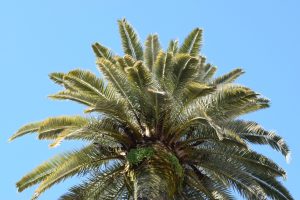
I was so excited to visit this site and it did not disappoint! I feel really lucky to be able to visit. I also loved the courtyard, which features running water (an essential component of cleansing before prayer for those practicing Islam), palm, orange, and cypress trees, as well as one very old olive tree. The palm trees are a Mediterranean tree that Abd al-Rahman liked so much that he wrote a poem about them in his old age. The cypress trees are from Iran and are usually used in cemeteries because their roots grow down, not out. The orange trees are not original to the courtyard, but were planted in the 13th century by Christians. Orange trees are from China and were brought to the area by the Arabs. 

A palm tree in the courtyard of La Mezquita Alhama de Córdoba

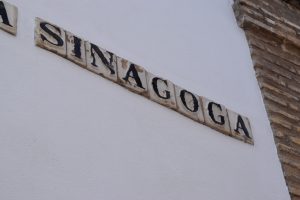
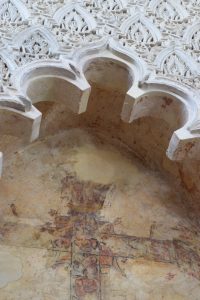
After visiting the mosque, we went on another walking tour to the Judería, or Jewish Quarter. The Judería is from the 1200s, after Christian conquest. We visited la Sinagoga de Córdoba which was built in 1315, and is one of 3 surviving synagogues in Spain, the other two being in Toledo. The synagogue was built in Arabic style, and the Jewish residents had to request permission from the Christian leaders at the time to build it.

The sign outside La Sinagoga de Córdoba, in La Judería.
The Arabic Architecture is highlighted here in La Sinagoga de Córdoba.

I enjoyed the walking tour, as usual, and I am excited to see what else I learn in Córdoba! I was really excited to visit this city because we read so much about it before departing, and I feel so fortunate to be able to visit the sites I have been reading about! 

I love the orange trees here, and I couldn’t decide on my favorite photo to share here!
I love the orange trees here, and I couldn’t decide on my favorite photo to share!

Thanks for following along! 

Emmaline
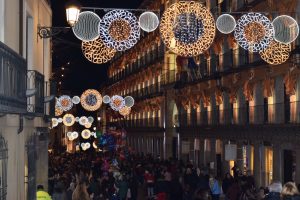
Toledo: The City of Three Cultures

Hello from Toledo, Spain! 

My name is Emmaline and I am a sophomore Anthropology major at Linfeld. I am currently studying abroad during January Term in Spain and Morocco, studying history and cultural encounters in cities throughout Andalusian Spain and Morocco. The course started at 5:30 AM on January 3, when I woke up to ride the shuttle to PDX. We then flew to Amsterdam (10 hours!), and then to Madrid (about 2 hours). We then took a bus to Toledo, about an hour south of Madrid. It is absolutely beautiful here and so full of history.

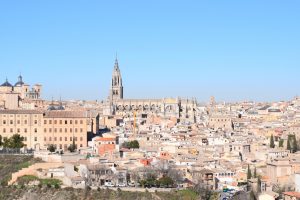
Toledo is surrounded by a river on three sides, making it an ideal site for a protected city

Toledo was an important city in the Iberian Peninsula for the Roman Empire, and then was taken over by the Visigoths during the 5th century when the Roman Empire had weakened significantly. The Visigoths established Toledo as their capital, and in 711, Toledo was taken by the Arab troops, looking to extend their empire. Toledo was taken back by the Christian Alfonso VI in 1085 during the Reconquista. Toledo is known as “The City of the Three Cultures,” as it was a rare city where Christians, Muslims, and Jews lived and co-existed together. All of this background is important because it explains why Toledo is a great city to study culture and history in. 

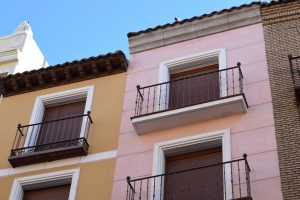
I love the colorful buildings in Toledo!
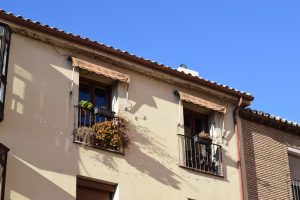
I love seeing all of the plants on balconies here in Toledo!

Today, we attended a lecture at the local university, La Universidad de Castilla – La Mancha. We learned a bit more about Toledo’s history, and that is where the great information I shared with you came from! Afterwards, we toured the university, which has archaeological sites inside it! There are Roman ruins and evidence of water collecting and distributing. I loved seeing this, as I want to study archaeology in the future. Later in the afternoon, we went on a walking tour of Toledo, where we explored sites significant to Muslim, Jewish, and Christian history in Toledo.

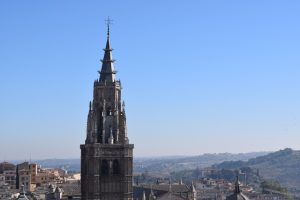
The main tower of the Toledo Cathedral

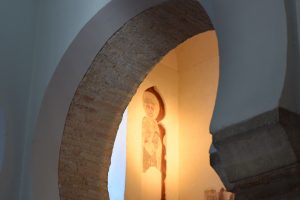
We visited La Mezquita del Cristo de la Luz, which was a small mosque built in 999. It was later turned into a Christian church, after the Reconquista. A wall was knocked down and an altar was added to transform the space, but of course, it still resembles a mosque! A Roman Road was discovered under the mosque in 2010, which was really cool to see.

Christian iconography viewed through an Arabic style arch in La Mezquita Del Cristo de La Luz

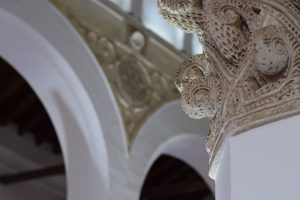
After the mosque, we visited Santa Maria la Blanca synagogue. All of the Christian names for Muslim and Jewish religious sites were added after they were transformed to Christian sites of worship, which is why they don’t exactly match up. The synagogue features Arabic architecture, because the best architects of the time were Arabic. This synagogue was also later transformed into a Christian church by adding an altar.

Arabic art and architecture in Santa Maria La Blanca Synagogue

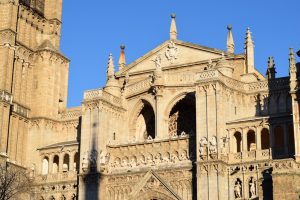
Lastly, we visited the Catedral Primada de Santa Maria. It is an incredible mix of architecture and highlights the mudejar architecture style, which is a mix of Muslim, Jewish, and Christian artistry. It has a beautiful altar, and is full of detailed work. I found it so interesting to see the sites I have been learning abut and preparing to see, and the co-existence that happened in Toledo throughout history. This created a very unique city to study culture and history in!

The main facade of the Toledo Cathedral
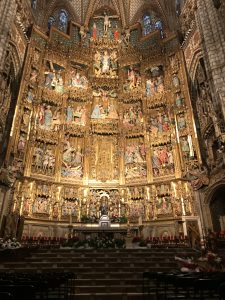
This altar depicts the life of Jesus Christ. Many people in Mesieval Toledo could not read, so the pictures made it possible to understand the stories of the Bible. This is made from painted, sculpted wood, and a lot of gold!

Tonight, we went to the parade for Three King’s day, which is tomorrow, January 6. This is the end of Christmas festivities here in Spain, and the parade was exciting. There were floats for each of the three kings, and afterwards, there were fireworks and people threw bouncy balls down into the square. It was a lot of fun and I am really glad I am able to experience an event like this in Spain!

The streets were packed for the Three Kings Day Parade!

I am enjoying Spain and I feel so lucky to be studying abroad here! I am so excited to see what the following days bring.

Thanks for reading and following along on this great adventure!