Deprecated: Function WP_Dependencies->add_data() was called with an argument that is deprecated since version 6.9.0! IE conditional comments are ignored by all supported browsers. in /chroot/home/a1e0f025/dab19c68f8.nxcli.io/html/wp-includes/functions.php on line 6131 Deprecated: Function WP_Dependencies->add_data() was called with an argument that is deprecated since version 6.9.0! IE conditional comments are ignored by all supported browsers. in /chroot/home/a1e0f025/dab19c68f8.nxcli.io/html/wp-includes/functions.php on line 6131

The Modern Wines of Campania

This post was written by sophomore Greyson Monaghan-Bergson, a wine studies major.
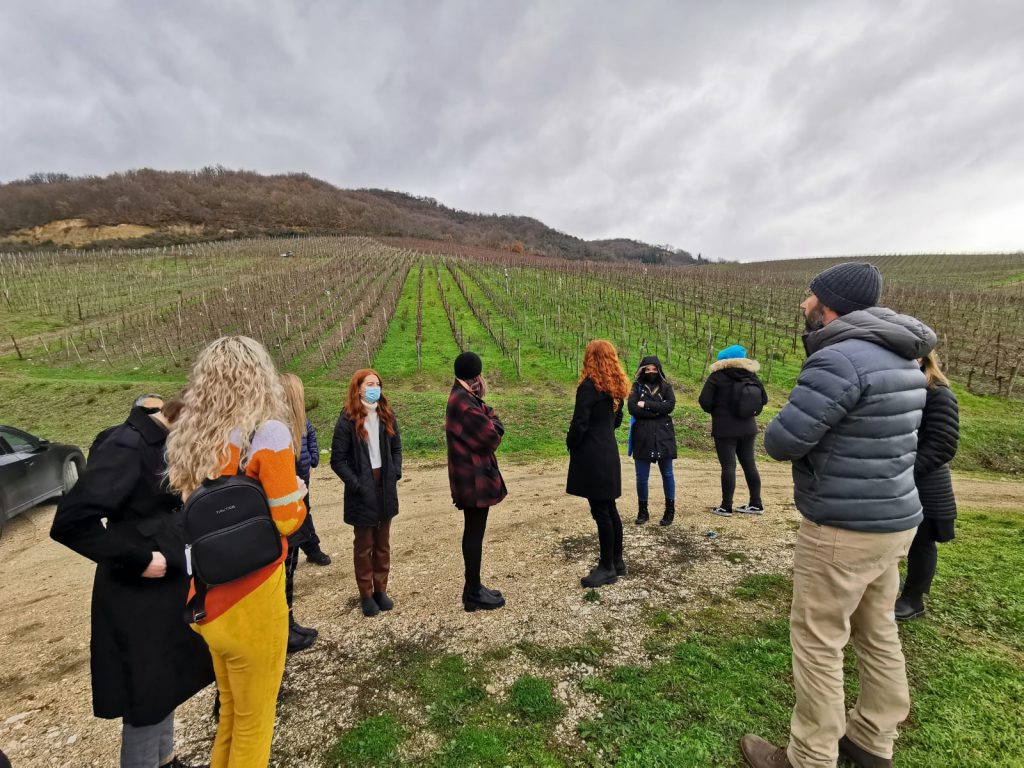
A group of students visiting a vineyard to learn about ongoing research.
Dr. Antonello Bonfante explains ongoing research in this vineyard that will help growers make adjustments for climate change. This vineyard is in the Greco di Tufo DOCG.

At the vineyard with the professors from the University of Naples, we were able to see some of the stuff we were lectured about firsthand. Namely the soil that Dr. Antonello Bonfante of the Italian National Research Council spoke of and the pruning methods that University di Napoli Federico II Professor Veronica de Micco touched on. On top of that, Arturo Erbaggio, also from the CNR,  showed us the experimental arch trellising method designed to create shade for the berries. They went on to explain that their goal for the project was to preserve the “freshness” of the wine which basically means keeping the acids high.

After the vineyard, we drove to Feudi di San Gregorio. The drive was only about half an hour but felt longer as the temperature of the bus slowly climbed to 30℃. At the winery, we got to look at the fermenting equipment. They had the biggest barrels I have ever seen! Their largest ones could hold 3000L. For comparison, the standard barrel used holds 255L, so those were pretty large. After that, we got to taste some of their wines. I’ll spare you the tasting notes but needless to say, they were very good. The wine they talked up the most was their Greco di Tufo. This wine is one of the most desirable abroad from Campania and for a good reason. This wine was just beautifully elegant yet took over your palate. On top of that, since it had high acidity it could be laid down and aged. I am definitely going to try that.

Next, we went to Quintedecimo to see Luigi Moio. He is a big name in southern Italian wine and certainly earned that reputation. Not only is he a professor at the University of Naples, the president of the International Organization of Wine and Vines (OIV), but he is also an amazing winemaker. We tasted four of his wines and once again the Greco took front stage. The best way I can describe it is as a wine whose depth keeps increasing with every sip. The thing that stuck out to me the most from all the wines today was that they were the opposite of anything people say about Southern Italian wines. They are usually described as big and jammy wines with no depth; but, these wines were insanely light and acidic making them taste super fresh!
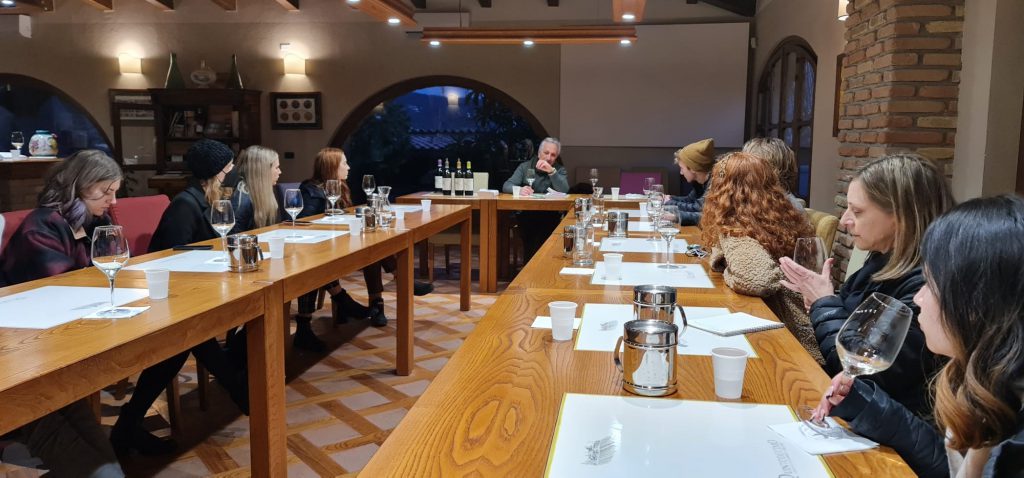
students sitting around long tables tasting wine.
The wines of OIV President and winemaker Luigi Moio we insanely light and fresh, despite Campania’s repuation for wines that are the opposite

Strolling the Streets of Pompeii

Today’s blog is guest-written by Sarah Mainwaring, a senior majoring in business

Today we went to the ruins of Pompeii, the ancient Roman city that was covered in ash by the 79 CE eruption of Mt. Vesuvius. Since the city was buried in volcanic ash, it was hidden and therefore preserved for centuries.

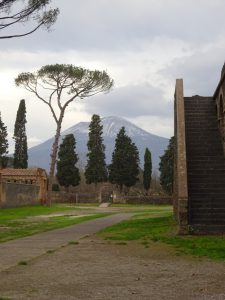
The entrance to Pompeii with Mt. Vesuvius looming in the background

The city wasn’t unearthed until the 1700s and then it’s historical value was revealed. The ruins provided historians with an accurate picture of what life was like in the Roman empire. It showed that the Romans were a sophisticated society with things like amphitheater’s, markets and extravagant villas. Pompeii is also home to a significant number of ancient skeleton replicas from those who perished in the volcanic eruption. The originals reside in the national museum of Naples so they can be properly preserved. These remains give us even more clues about the lives these ancient people lead. From what they ate, to their social status and physical biology.

We began our tour at the city’s colosseum, where ancient gladiators fought to the death for the entertainment of spectators. Our tour guide took us through the ruins and explained what the different rooms were used for, and who would have lived there 2,000 years ago. We learned what was original and what parts of the city have been patched up during the ongoing restoration.

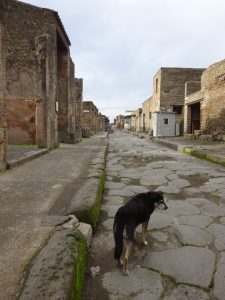
In addition to our human tour guide, we had a local dog join our group and accompany us through the tour. The locals call him Lupos and he’s apparently been living in Pompeii since he was a puppy. He was quite popular among the group.

A dog wandering the streets of Pompeii, Italy.
Lupos, a modern resident of Pompeii, stayed with us throughout our tour

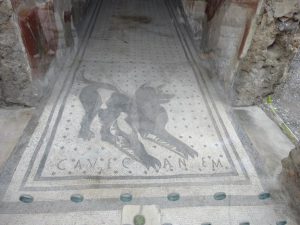
My favorite element of Pompeii was the artwork. Some of the walls had beautiful mosaics that have survived the eruption and the course of history. The thing I was most surprised by was the sheer size of the city, which covers almost 170 acres. Not only that but also the amount of detail and sophistication that went into the construction of the city. It was truly remarkable for a society as old as the Romans.

Mosaic floors.
Elaborate mosaic floors are still intact in some villas. This was one of our favorites.


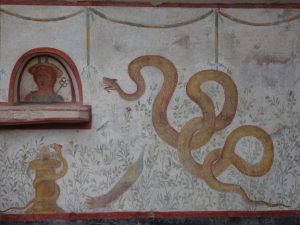
A serpent depicted in a stone wall carving.

Graffiti in Pompeii… from a Roman graffiti artist
Phallic symbols and graffiti at Pompeii…not so different from the Italy we know today.

Andiamo! We launch our study of the Volcanic Vineyards of Southern Italy

I’ve traveled all over the world. When I was the wine buyer for a regional grocery chain, I  accompanied my importer partners on visits to wineries and attended trade shows all over the world. My family still jokes about the dense itineraries for our family trips to Peru and England. When I began planning to take 14 Linfield students to Southern Italy to investigate the history of wine and modern viticulture in these volcanic regions, it seemed as though those trips would be adequate preparation. Then, Covid.

Every week it seemed there was a new form to complete, a complicated rule to untangle, and new hurdles to clear just to get the students into Italy. I’ve spent countless nights fretting about late PCR  test results and missing forms.

Some of those fears came to pass. A positive Covid test. A late PCR result. A suitcase that missed the plane. But we made it to our hotel – which just happens to be directly across the street from Herculaneum, a Roman town that was devistated by the same pyroclastic flow as Pompeii.

Over the coming three weeks you’ll hear more about our exploration of wine, food, and history of Campania and Siciliy from the students’ perspective.

Toni

Jan Term students on the plane ready for departure.
Linfield’s JanTerm 2022 gets underway aboard our flight to Italy.
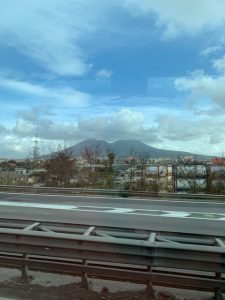
Landscape in Italy with Mt. Vesuvius in the background.
Exhausted, nearly all of us fell asleep on the bus between the airport in Rome and our hotel. When I woke up, Vesuvius was just out my window.