
After our mid-semester break, we started on our second-to-last course, Field Ecology. As someone with past experience in field research and who wants to continue doing it in the future, I was looking forward to this course, and it did not disappoint. On our first week, we spent the day on a field excursion to the island of Española, located almost directly south of San Cristóbal. As it is about the same distance as Santa Cruz, it was about a 2-hour boat ride to reach the island through fairly rough seas, although thankfully the water had calmed by the time we reached the island.
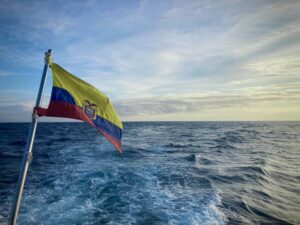
Sailing to Española.
Compared to the three other ‘major’ islands we had visited so far – San Cristóbal, Santa Cruz, and Isabela – Española was considerably smaller (37 square miles – less than a quarter of the size of the already-small San Cristóbal!) and had no human population. However, it is best known for its status as one of if not the only breeding sites of the waved albatross, which makes it a popular location for seabird enthusiasts.
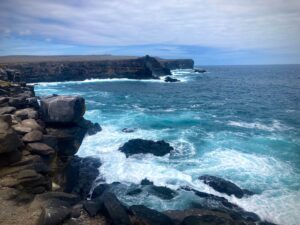
Rocky cliffs on the south shore of Española. Apart from these, the island is extremely flat and barren as can be seen in the distance.
We spent some time first snorkeling near the northern part of the island at a point known as Gardner Bay before landing on the island itself at Punta Suarez, on the island’s western tip, to observe the local wildlife, which included the albatrosses as well as several other seabirds, in addition to sea lions and marine iguanas, unique among lizards for their swimming and diving abilities.
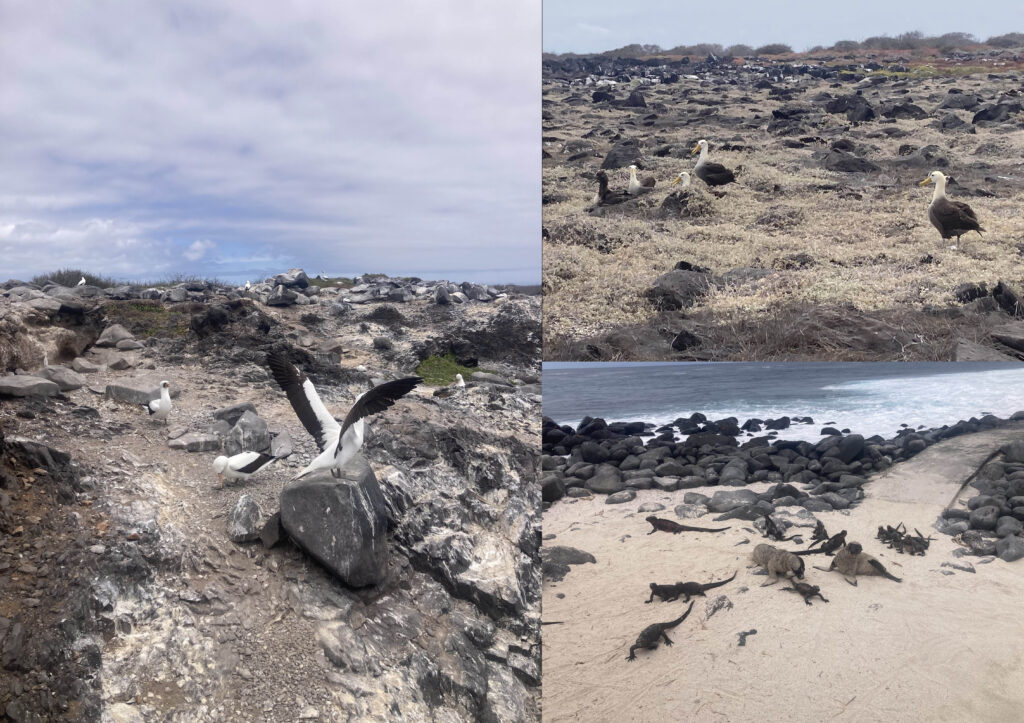
Top left clockwise: waved albatross, sea lion pups among marine iguanas, and Nazca boobies.
The second and third weeks of the class were focused on a local study on San Cristóbal that focused on incidences of bird roadkill on the island’s main road. As a part of this study, we had to go out several times and basically search for and collect (in a sanitary manner, of course!) dead birds along the side of the road.
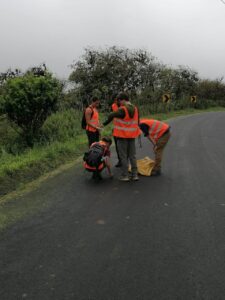
Bird sampling along the road.
Definitely morbid and unpleasant work, but that’s simply what the project entails sometimes – when, in this case, you need to know how many birds are getting killed on the road within a certain period, well, the only way to really find that out is to go out and see. So while it was definitely not anyone’s idea of a good time, I think it was a useful project to get us used to the idea that not all field science is necessarily “fun” work – this tied into other elements of the class that discussed field research and science from an ethical perspective, which I think was also a very interesting discussion to have that opened up new perspectives on how field research should be conducted.
Kai