
After the end of our Island Biogeography course, we had a one-week mid-semester break to round out our first month in the Galápagos. Although we had visited Santa Cruz before as part of our previous class, many of us wanted to explore more of the other islands in the Galápagos, so we decided to spend most of the week away from San Cristóbal.
Since we had been to Santa Cruz before, we decided to make our main objective the island of Isabela. The largest island on the Galápagos, but only the 3rd most populated, Isabela is known for its tall volcanoes and unique wildlife. To get there, we had to travel by boat again via Santa Cruz, and between the boat rides and a 4-hour “layover” in Santa Cruz, it took the whole day to reach the island.
The main town on Isabela, Puerto Villamil, was much smaller and less developed than the other ‘main towns’ of the islands we had visited. It had just a few paved roads and the rest being either made from brick or even just dirt and sand. For the first day, we went up to the highlands and hiked in the crater of Volcán Sierra Negra, where we saw active sulfur deposits. It was a very different change of scenery compared to the rest of the Galápagos, reminding me somewhat more of the Andes that we had spent time in on the mainland.
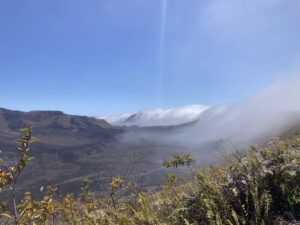
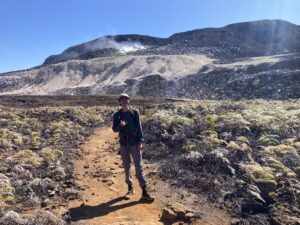
Hiking Sierra Negra.
We spent our second and third days on Isabela, mostly around town, surfing some waves by the beach and biking along the coast to the Wall of Tears. This was a remnant of the Galápagos’ past as a prison colony where prisoners were forced to build a wall by hand in a cruel act of pointless labor.
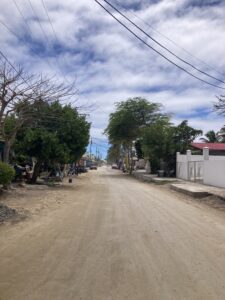
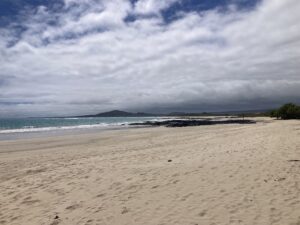
The streets of Puerto Ayora, and one of the beaches where we surfed.
On our fourth day, a few of us decided to take a boat tour to see more of the island. Like all islands of the Galápagos, only a tiny fraction of Isabela is accessible by car and as such, if you want to see other parts of the island you need to take a boat. We decided to travel around the southwestern coast, which would allow us to see a wide variety of marine and terrestrial life on and around Isabela.
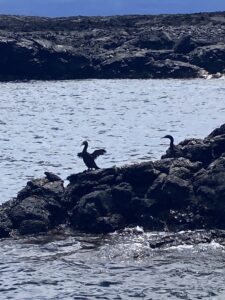
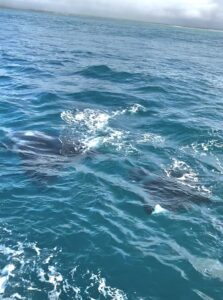
Some flightless cormorants and manta rays west of Isabela.
Over the course of the day-long trip, we traveled along the coast, stopping at various points to go onshore or go snorkeling. We saw a huge variety of life – among the highlights were orcas, manta rays, Galápagos penguins, flightless cormorants, several sharks, and seahorses!
On the fifth day of our break, we returned to Santa Cruz. We spent two more days there, exploring the island and Puerto Ayora a little further, before heading back to San Cristobal to spend the weekend relaxing before our next class started off.
Kai